Terror and Pity
Aleksandr Sumarokov and the Theater of Power in Elizabethan Russia
Format:Hardback
Publisher:Academic Studies Press
Published:31st May '16
Should be back in stock very soon
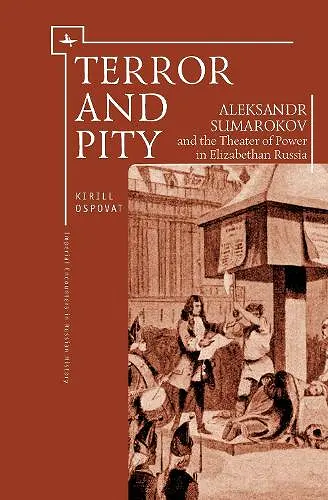
Situated on the intersection of comparative literary criticism, political history and theory, and cultural analysis, Terror and Pity: Aleksandr Sumarokov and the Theater of Power in Elizabethan Russia offers an in-depth reading of early Russian tragedy as a political genre. Imported to Russia by Aleksandr Sumarokov around 1750, tragedy reenacted and shaped the symbolic economy and the often disturbing historical experience of “absolutist” autocracy. Addressing half-forgotten texts and events, this study engages with literary and cultural theory from Walter Benjamin to Foucault and “new historicism” in order to contribute to a broader discussion of early modern “poetics of culture.”
“...this bowdlerized regularization of Shakespeare’s beloved play...elicits considerable scholarly interest. Ospovat’s reading of Gamlet through Machiavelli, Benjamin, and Schmitt transforms it into an astonishingly relevant depiction of the rise of charismatic tyranny during moments of political crisis (states of exception), perceived or real.” -- Catherine A. Schuler, University of Maryland, The Russian Review (Vol. 76, No. 3, July 2017)
“An impressive work of literary analysis and historical reconstruction that presents the tragedies of Alexander Sumarokov as focal points of the mythology of eighteenth-century Russian absolutism." -- Richard Wortman, Bryce Professor Emeritus of European Legal History, Columbia University
“Kirill Ospovat’s Terror and Pity is the most important work on Russian Elizabethan literature since the publication in 1936 of Grigorii Gukovsky’s path-breaking book on the noble fronde. The book analyses Sumarokov’s tragedies through the perspectives of Russian court politics, European political thought of seventeenth and eighteenth centuries, and modern political theory. This approach not only gives new life to the plays that did not look particularly engaging for a long time, but also allows to reinterpret the phenomenon of court theater and Russian eighteenth-century cultural history.” -- Andrei Zorin, Professor of Russian, University of Oxford
"The book advances an important claim for eighteenth-century Russian drama. In this study, tragedy, and perhaps even Russian literature of the period more generally, emerges as not merely borrowing from European models, but instantiating and fully participating in the political and literary dynamics broadly characteristic of early modern European court culture. Terror and Pity identifies and skillfully explicates the affective mechanisms that articulated power relationships for the elite theater audiences at the court of Elizaveta Petrovna. Ospovat’s case studies – Alexander Sumarokov’s two early tragedies Khorev and Gamlet – are aptly chosen to capture the Russian tragedic imagination at its very inception and to illustrate the book’s key argument: that in the absence of a full-fledged or fully permissible political theory, court theater came to perform the conceptual structures underwriting autocratic rule. Yet another of Ospovat’s signal achievements is the book’s thought-provoking engagement with the early modern theory of drama and politics in circulation in mid-18th century Russia; the influential twentieth-century writings of Walter Benjamin, Norbert Elias, and Carl Schmitt, as well as a rich array of recent scholarship on Russian history, European neoclassical tragedy, Shakespeare, and early modern court politics.” -- Luba Golburt, Professor of Slavic Languages and Literatures, University of California, Berkeley
ISBN: 9781618114723
Dimensions: unknown
Weight: 647g
336 pages