Dreams of Emancipation
A Transnational History of Revolutionary Russia
Format:Hardback
Publisher:Academic Studies Press
Published:25th Apr '25
Currently unavailable, our supplier has not provided us a restock date
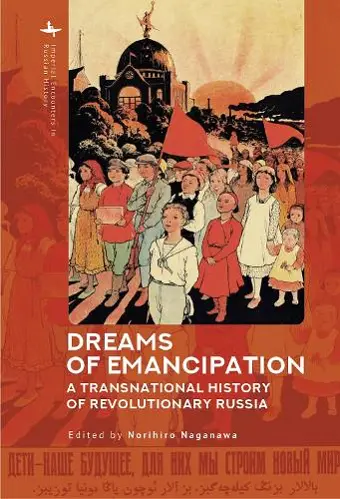
Given Russia’s invasion of Ukraine, why do emancipation messages that emanated from Russia count? Navigating multilingual sources, this book addresses the role of Russia’s multiethnic society and borderlands in generating kaleidoscopic repercussions of its 1917 Revolution. It also sees the USSR’s interactions with its neighboring countries as a crucible of the Soviet modality of communism. The book shows how the collapse of the Russian Empire further released a vast range of liberationist projects and dreams, far from confined to the goals of Bolshevism, in its borderlands and beyond, and how the Soviet Union became a highly ambiguous source of emancipatory inspiration in the long twentieth century overshadowing today’s global politics.
“In Dreams of Emancipation, Norihiro Naganawa presents an array of superb scholars who collectively convey the energy and anguish that revolutionary Russia exerted across the full expanse of Eurasia, from Poland to Manchuria and Siberia to Anatolia. Expertly crafted, the essays are attuned to the particular and specific while remaining in continual conversation with the universal and the thematic. They combine analytical precision with often evocative writing, making for readings that are consistently stimulating and even pleasurable. It is a wonderful volume.” — Michael A. Reynolds, Princeton University
“The Russian Revolution not only transformed the vast Russian empire but reverberated around the world. Bolshevik ideology helped articulate a vision of anti-imperialism, while the break-up of the empire inspired others seeking an end to empire. As this outstanding volume makes clear, understanding the impact of the revolution – both immediately and in the later decades of the twentieth century – requires looking beyond Petrograd and to the Russian empire’s colonized peoples. Not only did revolutionary ideas move to the Middle East, East Asia, and Europe through the Caucasus, Central Asia, Siberia, and the Ukrainian-Belarussian borderlands, but these areas continued to shape the USSR’s relations with its neighbors throughout the twentieth century.” — Artemy Kalinovsky, Temple University College of Liberal Arts
“One way to understand the Soviet era is as a complex sorting out of the emancipatory potential of the Russian Revolution. Gorbachev even tried to resurrect this power to fuel his Perestroika reforms. But what did emancipation mean to the USSR's diverse nationalities and neighbors? These richly researched essays by influential scholars are the first to dig into emancipation as transnational and transregional politics both inside and outside the state. The result is a compendium of new insights on one of the 20th century's most agonizing questions: How did a revolution that promised so much freedom end up delivering such enduring oppression, some of it staggering in scale? The answer, it turns out, is complicated, like the revolutionary legacy itself.” — Willard Sunderland, Winkler Professor of Modern History, University of Cincinnati
ISBN: 9798887196589
Dimensions: 233mm x 155mm x 17mm
Weight: 585g
290 pages