Feminist Medievalisms
Embodiment and Vulnerability in Literature and Film
Format:Hardback
Publisher:Arc Humanities Press
Published:31st Jan '24
Currently unavailable, and unfortunately no date known when it will be back
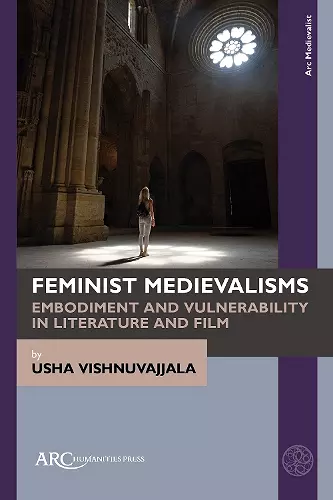
This book examines feminist textual and cinematic engagements with the idea of the Middle Ages in the nineteenth and twentieth centuries, arguing that the idea of the medieval past is central to the work of novelists and directors interested in embodiment and vulnerability. Careful and illuminating analysis of particular moments in fiction, film, and political discourse dismantles the false binary between popular and intellectual medievalisms, which rests on gendered understandings of genre and audience, while demonstrating that masculinist or patriarchal medievalisms have an equal but understudied counterpart.
The book's first three chapters cover Jane Austen’s Northanger Abbey and its afterlives, the final works of Virginia Woolf, and late twentieth-century film and music videos from the United States. The final chapter examines the treatment of women's bodies and vulnerability in both political theory and recent electoral politics, arguing that they share a common thread of misogyny rooted in the idea of the medieval past, and that one way to challenge that misogyny is by looking at complex feminist engagements with that same past, both real and imagined.
The book’s focus on medievalism in the writings of widely taught modern authors, as well as in visual media of the late twentieth century, means that it may be at least as useful to literary scholars working on other periods as it is to medievalists. This, in my view, is as valuable as it is unusual, demonstrating that medieval studies is neither stagnant nor insular. [...] The potential uses of this volume are many. I can envision it being used in classes on, for instance, women’s writing, or on medievalism in literature, or on medieval bodies, or on the history of emotions. It invites readers into conversation with the medieval and with medievalisms, and I hope it will be taken up by feminist scholars outside the broad field of medieval studies as well as within it.
-- Lucy C. Barnhouse * Medieval Feminist Forum 60, no. 1 (summer 2025): 250-53 *Vishnuvajjala makes her introductory stance on medievalism very clear, maintaining how most modern theory focuses on "institutional history, martial culture, or men’s writing" (1), with current medievalisms only addressing women in the context of misogyny, violence, or women as exceptions in otherwise masculinist spaces (1). Therefore, her introduction establishes a repeated theme of the text: how hierarchies affect our reading of both history and gender, and Feminist Medievalisms is her attempt at redefining medievalisms outside of masculine-coded concepts of power, authority, and institutions (5). Her alternative is a reading model that promotes vulnerability, connection, and an ethical understanding of one’s own time and place (6).
Vishnuvajjala outlines her methodology as a combination of textual analysis, and participatory, or experiential, medievalism. She specifically draws from Daniel T. Kline’s definition of “participatory medievalism”: the active decision to immerse oneself in a neomedieval environment (3). Interestingly, Vishnuvajjala chooses five case studies that do not involve a fictional neomedieval world at all. Instead, the author reiterates that these texts display embodied or experiential encounters with medieval women in a real or imagined past (4). [...] Vishnuvajjala’s own mode of "feminist medievalisms" may be vague and open to interpretation, but when taken individually, each chapter was an excellent analysis of Austen, Woolf, Sister Act, and Madonna. The author’s choice of texts is a relevant testament to her overall ethos, as it was especially refreshing to see a music video and a popular comedy film treated with equal relevance to Chaucer or Le Morte d’Arthur in modern medieval studies.
-- Rachel Denham-White * Limina: A Journal of Historical and Cultural Studies 30, no. 2 (October 2025): 66-ISBN: 9781641893831
Dimensions: unknown
Weight: unknown
142 pages
New edition