Medievalisms and Russia
The Contest for Imaginary Pasts
Format:Hardback
Publisher:Arc Humanities Press
Published:5th Mar '24
Currently unavailable, and unfortunately no date known when it will be back
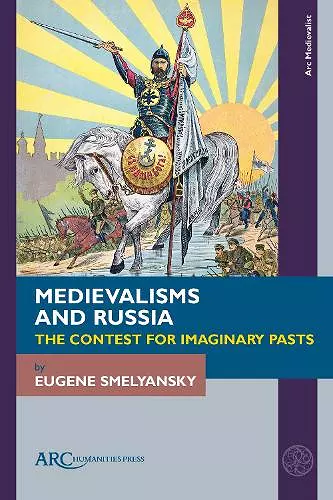
This new monograph is devoted to a detailed exploration of the ways in which the medieval past has been wielded to propagandic effect in Imperial, Soviet, and post-Soviet Russia.
From politicians’ speeches to popular culture, from Orthodox Christianity to neo-paganism, the medieval Russian past remains crucial in constructing national identity, mobilizing society during times of crisis, and providing alternative models of communal belonging. Frequent appeals to a medieval Slavic past, its heroes and myths, have provided—and continue to provide—a particularly powerful tool for animating imperialist and populist sentiments.
This study explores persuasive—and pervasive—recourse to tropes concerned with the Middle Ages in Imperial, Soviet, and post-Soviet Russia, seeking to explain why an often romanticized medieval past remains potent in Russian politics, society, and culture today.
Why has the medieval world captured the popular imagination in the twenty-first century? It is also a period associated with the birth of the nation and is central to national(ist) mythmaking. The latter has, of course, been a feature of many European medievalisms since at least the nineteenth century. Russia is no outlier, as Eugene Smelyansky points out, where already in the eighteenth century, the Imperial Academy of Arts and Sciences quickly alighted on early Rus—a medieval place or series of places founded by a Slavicized Viking diasporic elite—as the starting point for “Russian History.”
From the period of imperial Russia to today, early Rus has been synonymous with the national heritage and genesis of Russia, and also Ukraine and Belarus. In his pseudoscientific historical article preceding Russia’s invasion of Ukraine in February 2024, the President of the Russian Federation, Vladimir Putin, expressed the common heritage and ethnicity of the people of Russia, Ukraine, and Belarus, using early Rus as the starting point of a common history.
Why did Putin choose a remote medieval statelet on which to base his historical claim? Smelyansky’s book explores this and other instances of medievalism as intellectual nodes and cultural signifiers for Russian nationalism and supremacy.[...]
[T]he conclusion, although interesting, presents a missed opportunity to discuss a central node of Russian medievalism: the Mongols. It is a major oversight in an otherwise thoughtful and thorough overview of Russian medievalism and its influence on conservative politics to overlook the so-called “Tatar yoke.” This racist concept, central to both Russian (White and ethnic) supremacy and the Russian liberal epistemic orientation toward a “democratic” Europe and against a “despotic” East, represents a medieval-inspired race-making central to the colonial management of the indigenous peoples of Russia to this day.
-- Alexandra Vukovich * Speculum 100, no. 4 (October 2025): 1203ISBN: 9781802700640
Dimensions: unknown
Weight: unknown
136 pages
New edition