Pagans in the Early Modern Baltic
Sixteenth-Century Ethnographic Accounts of Baltic Paganism
Format:Hardback
Publisher:Arc Humanities Press
Published:31st Mar '22
Currently unavailable, and unfortunately no date known when it will be back
This hardback is available in another edition too:
- Paperback£34.95(9781802700220)
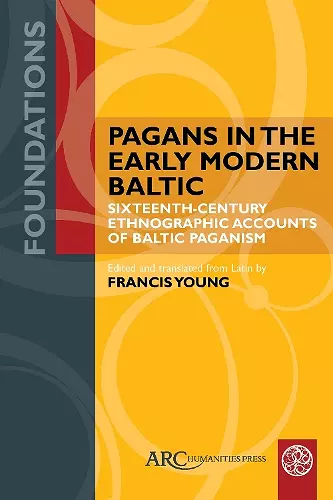
The Grand Duchy of Lithuania was the last European polity to renounce paganism and accept the Christian faith, at the end of the fourteenth century. However, the conversion of the Baltic region continued into the early modern period and the ongoing pagan beliefs and practices of Lithuanians and Prussians excited the interest of early ethnographers. This volume brings together Jan Łasicki's On the Gods of the Samogitians, Jan Malecki’s Little Book on the Sacrifices and Idolatry of the Old Prussians, and other Latin texts on Baltic paganism, none of which have hitherto been translated into English. A critical introduction places these texts, which are of interest far beyond the field of Central European history, in the contexts of early modern ethnography, Baltic history, and Reformation religious polemic.
The book Pagans in the Early Modern Baltic by Dr. Francis Young is a collection of translations into English of 16th century (the time limit has been somewhat extended by the author) documents dealing with non-Christian beliefs found on the Baltic territory.[...]
The texts themselves are known to scholars, though modern researchers cannot easily read the Letto-Preussische Götterlehre by Wilhelm Mannhardt, where these and most other texts relevant to the Baltic mythology are quoted and commented, as Mannhardt published all texts in the original language. The same texts (and many more) have been published by Norbertas Vėlius with Lithuanian translations in 1990s. The English translation of these is the novel aspect here, which is of no small importance, as research and sources usable for the study of the Baltic mythology in English are hard to come upon – previously, most of this has been written either in the local languages, or German, or Russian.
Francis Young refrains from evaluating the usability of the texts for recon- struction of the ancestral belief systems, indicating the shortcomings of the authors of the original texts, along with aspects that might have influenced their texts. However, Dr. Young suggests that with “utmost caution” it can still be done. He states that his task has been to provide the texts and put them in the historical context. This task appears to be quite satisfactorily completed.
-- Aldis Pūtelis * Journal of the Institute of Latvian History 118, no. 1 (2023): 176–- Winner of The Association for the Advancement of Baltic Studies—Book Publication Subvention Prize 2021 (United States)
ISBN: 9781641894371
Dimensions: unknown
Weight: unknown
192 pages
New edition