Multilingualism in Medieval and Early Modern Europe
Areas of Contact and Overlap
Format:Hardback
Publisher:Bloomsbury Publishing PLC
Publishing:26th Nov '26
£95.00
This title is due to be published on 26th November, and will be despatched as soon as possible.
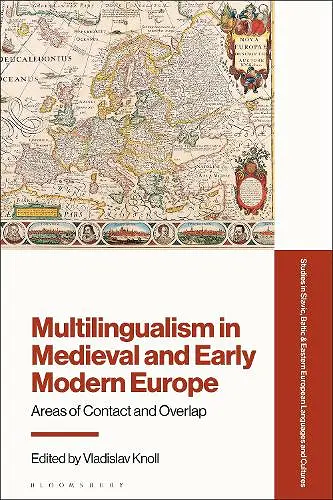
Explores historical multilingualism from the early Middle Ages to the beginning of the 17th century.
This interdisciplinary work explores historical multilingualism viewed from the early Middle Ages to the beginning of the seventeenth century.
It presents research methodologies related to different cultural areas of Europe covered by several classical languages. This approach aims to dispel the common misconception that Western Europe, dominated by Latin culture, constituted the only part of medieval Europe.
The volume consists of an extended introduction and twelve chapters reflecting different correlations of multilingualism and language contact in Western, Central, and Southeastern Europe during the period under study. The authors discuss various aspects of the relationship between classical languages and vernaculars, as well as the overlap of cultural areas. They adopt different points of view (multilingual texts, translations, language contacts, historical records of multilingualism), research methods, and applications of primary sources. Written by both seasoned scholars and young researchers, the chapters present novel concepts and point the way forward for the study of multilingualism, focused on the British Isles, Central Europe, and Southeastern Europe from various perspectives.
The chapters discuss both itinerant (traveling) and static multilingualism, as well as the confrontation of different languages in different mutual relationships. For the pre-modern period, such relations are linked to the varied social (diastratic) and functional roles of two types of languages: classical and vernacular. The confrontation of more classical languages or languages belonging to different cultural areas often involves scriptal pluricentricity. The book deals with a wide range of classical languages: Arabic, Armenian, Church Slavonic, Greek, Hebrew, and Latin. The vernaculars discussed include (Old and Middle) Czech, (Old) English, (Early New High) German, (Middle) Hungarian, Old Norse, (Old and Middle) Polish, (Old) Romanian, (Vernacular Middle) Greek.
Multilingualism is a well-known feature of the modern world. This richly documented and subtly argued collection shows it has always been with us, valuably extending our knowledge and understanding of the phenomenon back into earlier times. * Nigel Vincent, Professor Emeritus of General & Romance Linguistics, The University of Manchester, UK *
This volume explores an important yet underrated field in historical linguistics and sociolinguistics. Featuring significant researchers, the collection contains theoretical and empirical inquiries utilizing innovative methodologies. Of particular value is its main focus on the regions of Central and South-Eastern Europe, emphasizing their integral role in European cultural history. * Ivan N. Petrov, Associate Professor, University of Lodz, Poland *
ISBN: 9781666965605
Dimensions: unknown
Weight: unknown
376 pages