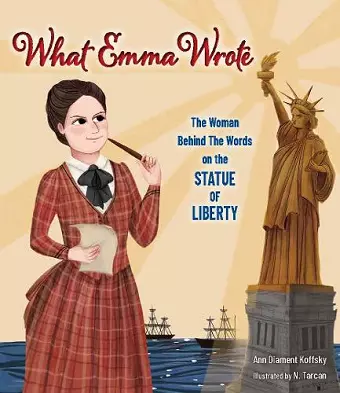
What Emma Wrote
The Woman Behind the Words on the Statue of Liberty
Ann D Koffsky author N Tarcan illustrator
Format:Hardback
Publisher:Behrman House Inc.,U.S.
Published:30th Apr '26
Should be back in stock very soon
STARRED REVIEW "A measured, resonant biography that frames writing as civic engagement." —School Library Journal
"An eye-opening look at a writer who spoke truth to power." —Kirkus Reviews
"History made to feel immediate." —Judith Magazine
With its poetic message of welcome, the Statue of Liberty holds an important and beloved place in American history. In time for anniversary of our nation's founding, this biography of the woman who wrote the now-famous poem on its pedestal has deep relevance for readers today.
Emma loved stories, loved writing poetry, and was curious about the world. When she met poor immigrants arriving in New York City, she knew she had to help. And when she was asked to write a poem about the Statue of Liberty, she imagined Lady Liberty as a mother, welcoming her children home. Her famous poem, “The New Colossus,” is still there on the statue’s pedestal, sharing its message of welcome with the world.
"'Give me your tired, your poor, your huddled masses yearning,' may be one of the most identifiable quotes in United States history, but few may know about the skilled author behind those words. Emma Lazarus (1849–1887) is presented as a writer whose devotion to language matures into moral clarity and civic purpose. From the outset, Lazarus’s immersion in books is not only a pastime but also helps form her creative interests. Disciplined reading and writing become the means through which she claims identity. Lazarus turns to language as deliberate moral expression. Language shapes how she sees the world and how she understands her responsibility within it. Set against 19th-century immigration and rising anti-Semitism, the narrative shows how historical pressures sharpened her sense of agency. When Lazarus encounters Jewish refugees seeking safety, her poetry expands in scope. Verse becomes public address; 'The New Colossus' stands as a literary achievement and a principled declaration, asserting belonging through artful intention. Tarcan’s illustrations mirror this movement from interior reflection to outward voice with warm earthy tones and clean lines that ground the setting historically, while Lazarus’s steady gaze signals resolve. VERDICT A measured, resonant biography that frames writing as civic engagement and self-authored identity."
—School Library Journal STARRED REVIEW
"A profile of Emma Lazarus (1849-1887), the poet who composed the words inscribed on the bronze plaque on the pedestal of the Statue of Liberty.
Growing up in a wealthy New York City family, Emma adored writing. She penned 'stories about ancient kings. Poems about brave goddesses. Essays about biblical heroes.' Emma’s proud parents had a book of her poems printed to share with friends and relatives. But Emma longed to do more with her talent, and when she overheard family friends complaining about immigrants ('They are so poor,' 'Their clothing is ragged'), she was galvanized. Descended from Sephardic Jews who faced persecution, Emma felt a kinship with Jewish immigrants who fled Russian pogroms. She helped new arrivals obtain food and clothing and started a school for them. She published articles about her experiences and one day was invited to write a poem for the Statue of Liberty; years later, her words still reverberate. In this concise, accessible biography, Emma emerges as a thoughtful activist and writer who used her words to effect real change. Taran’s stylish, elegant illustrations complement Koffsky’s prose. Author and illustrator draw an intriguing parallel between an impoverished mother Emma encounters on Wards Island and Emma’s conception of the Statue of Liberty: If the statue could talk, Emma thinks, 'she would be like a mother, welcoming her children home'—insightful commentary that should provoke discussion among readers.
An eye-opening look at a writer who spoke truth to power. (author’s note, more about immigration, Emma Lazarus, and the Statue of Liberty, photos) (Picture-book biography. 6-10)"
—Kirkus Reviews
"The Statue of Liberty is an iconic symbol of welcome to immigrants throughout the United States and the world. It became a sign of inclusion and acceptance due to the words of a poet, Emma Lazarus, whose immortal lines are inscribed upon its base.
Emma Lazarus was a Jewish woman who lived in the 1800s. She had always loved to write. As a child, she used her fertile imagination to record stories which she loved to share with family and friends. She had a special feeling of warmth toward immigrants, knowing that her family had immigrated, too; because they were Jewish, they had to escape from their homeland and they came to the United States to begin new and better lives. As a young woman, Emma spoke to many of the immigrants who were arriving daily to Wards Island in New York Harbor. She listened with love and caring to their stories of hardship and to their hopes for the future. She helped these immigrants in numerous ways, providing food and clothing and arranging for education and jobs. She fought the misinformation and fear engendered by the media of the day by writing articles in their defense. Her writing helped to ameliorate some of the harsh conditions of their lives.
Emma heard about the Statue of Liberty before it was completed. She was invited to compose a poem that would be inscribed on its base. She envisioned the giant statue as a loving mother welcoming her people home. The poem she wrote was admired and accepted with joy. It inspired waves of immigrants who found their places in a new land and pointed them toward a better future.
An appended author’s note explains more about the Statue of Liberty and what it has meant throughout the years to those seeking freedom. Ann Diament Koffsky shares the story of her grandparents who immigrated to the United States in the 1920s. She explains that the United States is known as a haven for immigrants who seek a new life and a freedom which they have been denied. Photographs of the statue and facts about its design are included. Color illustrations by N. Tarcan evoke a feeling of time and place, enhancing this book and providing a feeling of optimism and hope."
—Jewish Book Council
"Ann Koffsky’s What Emma Wrote - The Woman The Woman Behind the Words on the Statue of Liberty is a beautifully crafted picture book that celebrates courage, creativity, and the power of words. Koffsky creates a deeply moving portrait of a girl who loved language and grew into a woman determined to use her voice to make a difference.
N. Tarcan’s illustrations are filled with warmth and perfectly compliment the text. Emma Lazarus’s personal story is connected to the values of welcoming the stranger, compassion, and justice. History is made to feel immediate and the lessons Emma voiced resonate deeply today."
—Judith Magazine
ISBN: 9781681157191
Dimensions: unknown
Weight: unknown
40 pages