Reading Nature in the Early Middle Ages
Writing, Language, and Creation in the Latin Physiologus, ca. 700–1000
Format:Hardback
Publisher:Arc Humanities Press
Published:30th Nov '23
Currently unavailable, and unfortunately no date known when it will be back
This hardback is available in another edition too:
- Paperback£34.95(9781802701661)
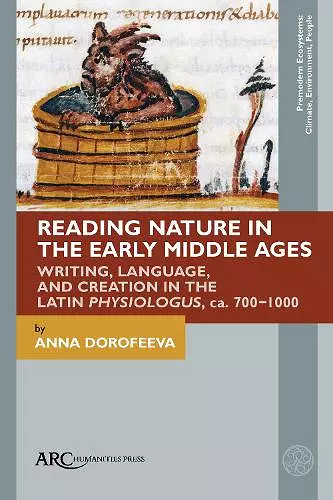
This book is a new cultural and intellectual history of the natural world in the early medieval Latin West. It examines the complex relationships between language, texts, and the physical world they describe, focusing on the manuscripts of the Physiologus—the foundation of the medieval bestiary. The Physiologus helped to shape the post-Roman worldview about the role and place of human beings in Creation. This process drew on classical ideas, but in its emphasis on allegory, etymology, and a plurality of readings, it was original and distinctive. This study demonstrates precisely how the early medieval re-contextualization of existing knowledge, together with a substantial amount of new writing, set the course of ideas about faith and nature for centuries to come. In doing so, it establishes the importance of multi-text miscellanies for early medieval written culture.
Anna Dorofeeva points out in her important first monograph, Reading Nature in the Early Middle Ages, this emphasis on scholastic writing not only sidelines noninstitutional, or "folk," knowledges but also occludes the innovations of writers in previous centuries, who are often dismissed as mere compilers of preexisting ideas. Dorofeeva argues that compilation—whether within a single text or in the sense of producing a composite manuscript—was itself an intellectual and creative exercise. Her evidence consists largely of meticulous studies of manuscripts containing the Latin Physiologus, a collection of short descriptions of animals, plants, and stones that influenced later medieval bestiaries. The result is a compelling narrative that treats manuscript studies as integral to the history of knowledge. [...]
[R]readers will appreciate Dorofeeva's ability to comprehensibly summarize large areas of scholarship. Granted, her primary audience will likely be scholars of early medieval Europe, but her rigorous codicological and paleographical analyses lay crucial groundwork for studies of the text's reception in later centuries as well. Portions of Reading Nature, such as the panoramic first chapter, may even interest environmental humanists concentrating on other periods. This is an important book for anyone invested in premodern views of nature, ordinary manuscripts, and the political agendas that influenced both.
-- Aylin Malcolm * Manuscript Studies: A Journal of the Schoenberg Institute for Manuscript Studies 10, no. 1 (Spring 2026): 247-50, https://doi.org/10.1353/mns.2025.a9655ISBN: 9781802700022
Dimensions: unknown
Weight: unknown
266 pages
New edition