The Disappearing Act Signed Bookplate Edition
Maria Stepanova author Sasha Dugdale translator
Format:Paperback
Publisher:Fitzcarraldo Editions
Published:26th Feb '26
It is possible we may get a copy in future, but unfortunately unlikely
This paperback is available in another edition too:
- Paperback£12.99(9781804272329)
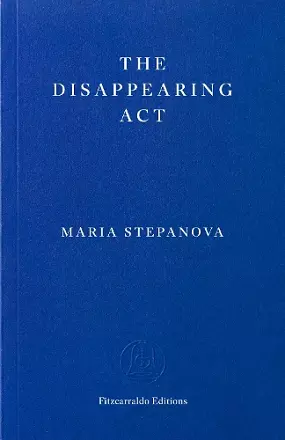
The writer known as M. is living in exile while her home country wages war on a neighbouring state. Wracked by shame and severed from her language, M. finds herself unable to write, unmoored in a present where the future feels unknowable. When she travels to a nearby country for an event, a twist of fate leaves her stranded in an unfamiliar city, phoneless and untraceable. In this rupture, she feels a flicker of liberation – the possibility of starting over – but memories of childhood, books, films and tarot cards pull her back, the last fragments of a vanishing world. Then she meets a troupe of circus performers who invite her to join them. For a moment, reinvention seems within reach. Oscillating between reality and dream, written in rich, hypnotic prose, The Disappearing Act is a haunting meditation on identity, language and the fragile desire to disappear by Maria Stepanova, one of Russia’s greatest living writers.
‘Essential… Written with deep insight, despair and an intrinsic sense of the alarming recurrence of the present’s failure to learn lessons from the past. The Disappearing Act, expertly translated by Sasha Dugdale, is the dreamlike testimony of a novelist, known simply as M, who is witnessing from exile her country of origin’s invasion of a separate sovereign state. Creatively and psychologically paralysed by the horrors of war seen at a distance, M can no longer write; every innocuous image becomes superimposed with horror, and so she retreats into self-erasure and memory in order to survive, never mind evolve.’
— Catherine Taylor, Irish Times
‘The Disappearing Act is about what happens when the story of one’s life cleaves in uncomfortable, incongruous ways…. Much of the novel exists on this symbolic plane. But Stepanova is equally adept at building a physical world that evokes the experience of exile…. If there is a through-line to Stepanova’s work, it is not some grand, totalizing vision but rather the habit of looking closely at what falls through the cracks.’
— Matthew Janney, Financial Times
‘M describes the country she comes from as a “beast” waging war against its neighbour. We can guess her meaning without turning to the author’s biographical note. Maria Stepanova – whose masterly In Memory of Memory combined family memoir, essay and fiction – left her native Russia after its full-scale invasion of Ukraine in 2022. We might also wonder how closely The Disappearing Act tracks her own life. But the novelist M is not here to discuss autofiction – she has more important things to reflect on…. Wherever her escapade brings her next, she is proof that it takes a novelist with poetic imagination to capture the nature of the beast.’
— Anna Aslanyan, Guardian
‘Essential… Written with deep insight, despair and an intrinsic sense of the alarming recurrence of the present’s failure to learn lessons from the past. The Disappearing Act, expertly translated by Sasha Dugdale, is the dreamlike testimony of a novelist, known simply as M, who is witnessing from exile her country of origin’s invasion of a separate sovereign state. Creatively and psychologically paralysed by the horrors of war seen at a distance, M can no longer write; every innocuous image becomes superimposed with horror, and so she retreats into self-erasure and memory in order to survive, never mind evolve.’
— Catherine Taylor, Irish Times
‘Stepanova deliberately withholds clear answers, and this ambiguity is what makes The Disappearing Act so compelling. It is driven by uncertainty, the unwillingness to face oneself, and the sense that one’s language – and, of course, their whole world by proxy – is collapsing beneath one’s feet…. [T]he novel can be marked as one of the first major works of the new Russian literature, a cogent exploration that is never prescriptive nor totalizing, but simply captures something of the diffuse, unfinished, and hopelessly divided moment.’
— Sam Bowden, Asymptote
‘Political evil has re-emerged across the West, imposing agony upon all people of conscience, and new challenges on writers and artists. In her incandescent poems and essays, Maria Stepanova has never shirked the weight of history long borne by writers from Russia, Asia, Africa and Latin America. Her artistic, intellectual and spiritual resources seem even richer in her first novel, The Disappearing Act. I have not read a novel that attests, with such melancholy precision, to the shame, absurdity and confusion of being human today, or describes so acutely the immense but too often frustrated craving for radical self-transformation.’
— Pankaj Mishra, author of The World After Gaza
‘A profound, unsettling meditation – at once lucid and mournful – on political exile, reinvention after the rupture of belonging, the writer’s reckoning with collective responsibility, and the beasts we carry – national, ancestral, unnamed – that shape us even as they threaten us.’
— Lea Ypi, author of Free
‘The Disappearing Act is a witty, unsettling and profound reflection on belonging and estrangement.’
— Abdulrazak Gurnah, 2021 Nobel Prize in Literature laureate
‘In this captivating and capacious novel from Stepanova (In Memory of Memory), a 50-year-old novelist experiences a bizarre and liberating metamorphosis while in exile from her unnamed home country, which has just started a devastating war with its neighbour.... Far from a literary gimmick, the novel comes across as an urgent call to resist complacency and recover one’s vitality in the face of injustice. It’s a stunner.’
— Publishers Weekly, starred review
‘Extraordinary – a work of haunting power, grace and originality.’
— Philippe Sands, author of East West Street (praise for In Memory of Memory)
‘Intentionally the memoir is meandering, digressive, cumulative, compendious – a mind moving around its wide world. Dugdale’s translation appears heroic, to this reader with no Russian, in its sustained careful attentiveness…. [S]o much of what Stepanova has saved for us is remarkable and rich with meaning.’
— Tessa Hadley, Guardian (praise for In Memory of Memory)
‘A luminous, rigorous, and mesmerizing interrogation of the relationship between personal history, family history, and capital-H History. I couldn’t put it down; it felt sort of like watching a hypnotic YouTube unboxing-video of the gift-and-burden that is the twentieth century. In Memory of Memory has that trick of feeling both completely original and already classic, and I confidently expect this translation to bring Maria Stepanova a rabid fan base on the order of the one she already enjoys in Russia.’
— Elif Batuman, author of The Idiot (praise for In Memory of Memory)
‘There is simply no book in contemporary Russian literature like In Memory of Memory ... [A] truly major European writer. I am especially grateful to Sasha Dugdale for her precise and flawless translation which makes this book such a joy to read in English. This is a voice to live with.’
— Ilya Kaminsky, author of Deaf Republic (praise for In Memory of Memory)
‘Stepanova’s tour de force blends memoir, literary criticism, essay and fiction. Although this is a personal and intimate work using photographs, postcards and diaries, it succeeds in mining a universal theme in contemporary Russian cultural life: how does a family – or a country – process the events of the past 100 years?’
— Viv Groskop, Guardian (praise for In Memory of Memory)
‘Dazzling erudition and deep empathy come together in Maria Stepanova’s profound engagement with the power and potential of memory, the mother of all muses. An exploration of the vast field between reminiscence and remembrance, In Memory of Memory is a poetic appraisal of the ways the stories of others are the fabric of our history.’
— Esther Kinsky, author of Seeing Further (praise for In Memory of Memory)
‘This remarkable account of the author’s Russian-Jewish family expands into a reflection on the role of art and ethics in informing memory.… Stepanova is both sensitive and rigorous.’
— New Yorker (praise for In Memory of Memory)
ISBN: 9781804272329-SB
Dimensions: 197mm x 125mm x 15mm
Weight: 190g
136 pages