Infrastructural Critique
Contemporary Art Between Reproduction and Abolition
Marina Vishmidt author Stefano Harney author Fred Moten author Danny Hayward editor Kerstin Stakemeier editor Larne Abse Gogarty editor
Format:Paperback
Publisher:Verso Books
Publishing:17th Nov '26
£14.99
This title is due to be published on 17th November, and will be despatched as soon as possible.
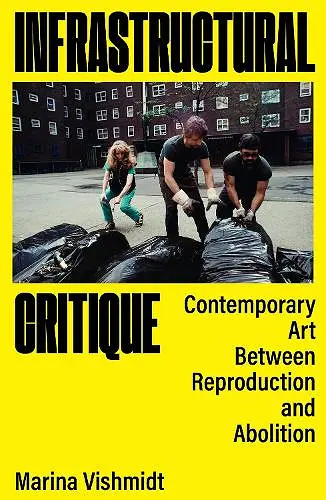
A theory of art and infrastructure by one of the most brilliant critical theorists of her generation
As we search for ways to imagine a life beyond capital and its drive to extinction, the dream of the institution as a critical refuge from existing social relations becomes less and less credible.
Infrastructural Critique proposes a new materialist counter-praxis. By treating the contemporary art institution as a resource base and site of struggle, Vishmidt reanimates critique by connecting it to the effort to erode capitalist authority over the means of our existence, build power and seize resources for new practices of social invention.
A tour-de-force of Marxist philosophy, art criticism, Milanese radical feminism and AppleTV+ dinosaur documentaries, this book, edited in the wake of the author's tragic early death, weaves in the gaps of theory and praxis to assess the main infrastructurally critical artmakers at work today. Approaching their practices as 'crystal drills' - at once means of seeing, and practical cutting implements - the text showcases the light-bending, life-shaping thinking of one of the most playful, politically radical theorists of her generation.
Marina Vishmidt speaks with unfailing clarity about how value feeds on devastation and how art's institutions sit inside the chain of extraction rather than outside or above. Infrastructural Critique is essential reading for anyone who despite all is not ready to give up on the artworld as a place for collective struggle, and who not only wants to experience how 'infrastructural critique' pulls conditions of possibility into the frame -- above all, the material conditions of reproduction -- but more importantly, crack open the impasses and alibis of institutional critique. What makes this book, her last gift to us, so generative is that it never stops at the diagnosis: between reproduction and abolition it opens ground for new forms of origination. * Anselm Franke *
Marina Vishmidt's articulate and incisive volume examines the conditions under which art is made and circulated. Here, solidarity is not an ideal, but a necessary strategy capable of antagonising and retooling the infrastructures that organise everyday life and culture. Exposing the creative industries' entanglements with infrastructures of domination, her uncompromising analysis builds a careful yet ambitious argument for an art that goes beyond mere representation or commentary. In its place, she narrates examples of art work that actively divests from systems of social neglect, and reconfigures labour relations through forms of collective organising, institutional abandonment and self-abolition. An essential handbook for cultural workers seeking to understand and transform their workplace, this is nothing short of a call for a collective rebellion. -- Mason Leaver-Yap, associate curator at KW Institute for Contemporary Art
Marina's intellectual practice truly constituted a form of praxis, and her work was always situated in a commonly sensed world. Thinking with Marina by reading her, following her through so many encounters with other practices, is to feel the tender exhilaration of negation. She was never interested in branding herself through quasi-proprietary concepts. While Marina did, of course, develop crucial concepts such as infrastructural critique, those need to be seen as part of a method that operationalizes rather than fetishizes them. Guy Debord (who was not necessarily Marina's favourite) once noted that, according to the dominant standards, the style of dialectical theory is a scandal because, "while it makes concrete use of existing concepts, it simultaneously recognizes their rediscovered fluidity and their inevitable destruction." In those terms, Marina's work is wonderfully scandalous. -- Sven Lütticken, author of Objections: Form of Abstraction, Vol. 1
What is to be undone? How? With whom? Ensnared in capital's negative totality, it is tempting to imagine that we can find refuge in experiences of care, reproduction, and life before and beyondcapitalism, or, alternatively, that we can decree capital's integral abolition. In this indispensable book, Marina Vishmidt - with the intransigent generosity that marked her life and work - demonstrates that 'critique as a material practice of antagonism' must eschew abstract radicalism to fight instead on the terrain of infrastructure, where value and waste, relations of production and relations of destruction, intersect. Vishmidt teaches us that 'there is no opposition between breaking and building.' Infrastructural Critique is an irreplaceable invitation and guide to the work of abolition. -- Alberto Toscano, author of Late Fascism
Marina Vishmidt's rigorous examination of the many facets of reproduction is essential for understanding the systems of relations guaranteeing capital's accumulation and its potential subversion. This insightful book will be valuable to theorists and organizers alike invested in subverting the reproduction of value and in building a different world held in common. -- Silvia Federici, author of Caliban and the Witch: Women, the Body and Primitive Accumulation
Marina's friendship and the fruits of her incredible mind have been an irreplaceable source of nourishment for the part of ourselves that is the weakest, the sickest, the least equipped to resist the harshness of the present circumstances, precisely because it is the part that will carry us when this present is abolished and new forms of freedom and intelligence revive the dying world. Infrastructural Critique looks systematically into all the unsolvable issues of our failed struggles, our poverty, our entrapments and our incapacity to fight back against the forces that are not just undermining our political position, but threatening the possibility of life on earth. And yet it leaves us the tools to navigate all this with an accrued sense of reality, one that brings us back to this earth that is ours where she no longer walks with us. Pragmatic and anti-moral, in her distinctively visionary way, Marina's writings are both an unreachable horizon of sharpness and a safe place where everything makes sense for us. This book will live forever as the witness of a transition outside of the superstitions of class struggle and the aporias of identity politics, it will be the stepping stone to get to the position where we can look in the eye all the unsolved problems that we are living with, from the genocide in Palestine to the return of fascism, from patriarchy to global warming, from the uselessness of abstract intellectualism to the generalisation of mental illness. It will remind us that we can and must flee and fight back, build and destroy, think with each other and against ourselves when needed, and above all that we mustn't be overwhelmed by grief about the ones that we have lost and the worlds that disappear, but make them live in our shared reality as inspirations and possibilities, creating the present where they could have flourished with us. -- Claire Fontaine, feminist conceptual artist, founded in Paris in 2004
Marina's blazingly brilliant theories about infrastructure and labour help light the path for every student, critic, artist, and activist who is engaged in collective struggle towards a more just art world. -- Julia Bryan-Wilson is Professor of Contemporary Art and LGBTQ+ Studies at Columbia University
ISBN: 9781836741596
Dimensions: unknown
Weight: 150g
192 pages
Paperback original