The Elite Center Cannot Hold
Critical Perspectives on Resurgent Philippine Liberalism
Tom Sykes author Maria Diosa Labiste author
Format:Hardback
Publisher:Anthem Press
Publishing:1st Sep '26
£80.00
This title is due to be published on 1st September, and will be despatched as soon as possible.
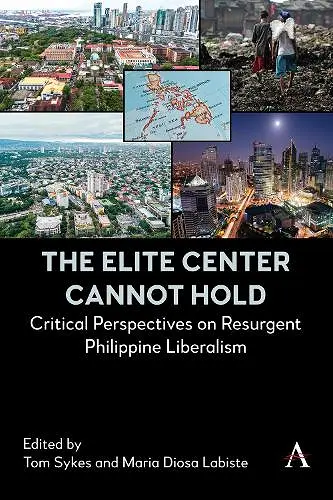
Explores the rise of resurgent Philippine liberalism, its ties to neoliberalism and U.S. influence, and its role in exacerbating inequality and geopolitical tensions, rooted in both contemporary and historical contexts
A resurgent liberalism has become hegemonic in Philippine media and academic discourses, which were previously characterized by progressive and nationalist perspectives. While resurgent Philippine liberalism (RPL) has been precipitated by recent and current crises.
A resurgent liberalism has become hegemonic in Philippine media and academic discourses, which were for many years characterized by progressive and nationalist perspectives. Resurgent Philippine liberalism (RPL) is defined by its relationships with neoliberalism’s instantiation in the Philippine economy and society and the neoliberal wing of the contemporary Philippine political elite. The transnational positionality of many of its exponents has allowed RPL to converge with and support the priorities of U.S. military, economic, and cultural power, especially since the projection of this power has been cloaked in the progressive rhetoric of “human rights,” “freedom of speech,” “anti-populism,” “anti-disinformation,” and so on. Moreover, RPL intersects with new technologies, forms of social capital, and iterations of dynastic politics, while playing a deleterious role in domestic and global crises that are intensifying inequality and geopolitical conflict. While RPL has arguably been precipitated by current affairs and concomitant anxieties (such as about U.S.–Philippine elite relations in a new multipolar geopolitics), it also has long-term historical roots in the post-Marcos era of elite democracy and further back to the origins of ilustrado liberalism and reformist nationalism in the nineteenth century.
This book makes certain novel theoretical interventions by interrogating the defining assumptions of the liberal critique of Philippine autocracy, which all too often exculpates U.S. imperial power (in both its “hard” and “soft” forms) in sustaining such regimes, rejects more holistic and materialist theories of socio-political change as precipitated by mass-movements of the working-class, and naively proposes Philippine elite liberal politics and/or the Western model of “liberal democracy” as viable alternatives to Philippine authoritarian populism.
In addition to this empirical, real-world analysis, the book is concerned with the ontological, epistemological, and more broadly theoretical dimensions of RPL, as manifested in Philippine academia, journalism, politics, activism, and culture. In its rejection – covert or overt – of formerly pre-eminent materialist theories of social change precipitated by mass movements of working-class people, RPL risks either resuscitating classical liberal methodologies such as the Great Man Theory of History or offering some new techniques for gaining...
ISBN: 9781839995767
Dimensions: 229mm x 153mm x 13mm
Weight: 454g
100 pages