This Mob Will Surely Take My Life
Lynchings in the Carolinas, 1871-1947
Format:Hardback
Publisher:Bloomsbury Publishing PLC
Published:15th Jan '09
Currently unavailable, and unfortunately no date known when it will be back
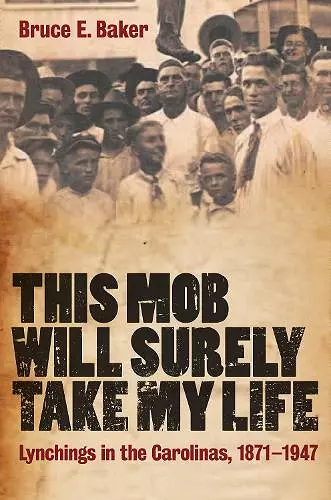
Lynching marked the violent outer boundaries of race and class relations in the American South between Reconstruction and the civil rights era. Everyday interactions could easily escalate into mob violence. This book examines this aspect of American history by taking seven lynchings in North Carolina and South Carolina and studying them in detail.This book presents a comprehensive history of lynching and mob violence in North and South Carolina, focusing on seven specific case studies from the region. Lynching marked the violent outer boundaries of race and class relations in the American South between Reconstruction and the civil rights era. Everyday interactions could easily escalate into mob violence, and did so thousands of times. Bruce Baker examines this important aspect of American history by taking seven lynchings in North Carolina and South Carolina and studying them in detail. He succeeds in getting behind the superficial accounts and explanations provided at the time to explain the deeper causes and wider contexts of these events.Many studies of lynching begin only after Reconstruction had ended and African Americans found themselves with little political power. However, this book provides the most thorough study yet written of the Ku Klux Klan's most violent episode - the killing of thirteen black militia members in Union, South Carolina, in 1871 - to argue that this act of mob violence set the conditions in important ways for the entire lynching era. Enmities born in Reconstruction lingered afterwards and lay behind an 1887 lynching in York County, South Carolina. As lynching became an unsurprising part of life in the South, African Americans even found that they could use it themselves, in once case to punish a child's killer and in another to settle a church's factional squabbles. In addition, a variety of forces opposing lynching was rising and by the 1930s their efforts would begin to make a difference.
Mention -Book News, February 2009
"By focusing on seven discreet incidents Baker makes the pattern of lynching in one part of the American South concrete and grounded in the social world that black and white southerners fashioned together. In this light, This Mob Will Surely Take My Life becomes a good starting point for an assessment of the relationship of mob violence to racial politics in the postemancipation South and North Carolina."-The Journal of American History, Dennis B. Downey, Millersville University, Millersville, PA
This Mob Will Surely Take My Life is a major addition to the literature on collective violence in the post-Civil War South. Through these well-researched case studies, the author succeeds in tracing the rise and decline of lynch law in the Carolinas, proving in the process how its persistence and pervasiveness negatively affected both races and all levels of society for more than three-quarters of a century. -- Christopher C. Meyers, Valdosta State University * The South Carolina Historical Magazine *
ISBN: 9781847252388
Dimensions: unknown
Weight: unknown
256 pages