Everything Passes
Format:Paperback
Publisher:Carcanet Press Ltd
Published:28th Sep '06
Should be back in stock very soon
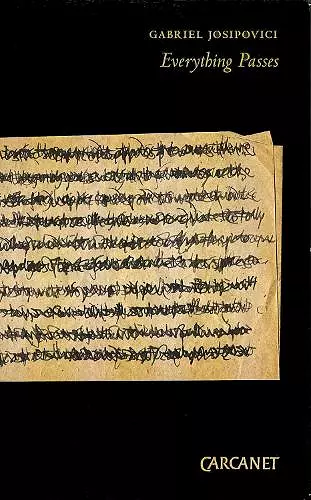
Everything passes. The good and the bad. The joy and the sorrow.
Everything passes.
Or does it?
A man stands at a window, looking out. Behind him, a room, bare of people and of furniture. Fragments of conversations drop into his head, conversations with his first and second wife, with his children, with his friends. A life can slowly be pieced together, culminating in a terrifying near-death experience.
Gabriel Josipovici has created a compressed, poetic narrative of solitude, love, illness and the ambiguous comforts of art. As clear and elusive as the arts it explores, this is the most beautiful and mysterious of Josipovici's books to date.
Gabriel Josipovici's newest book enters a world that does not have a name for it. The term 'novel' is wrong, not so much on grounds of the work's shortness (just 60 pages, with generous amounts of space) as of its structure. The text is divided into short scenes, as one might call them, ranging in length from the description of a setting in three short lines to sequences of dialogue that play over three pages. There are 80 of these passages, and the first seven make it very plain that recurrence is going to play a large role. First comes an element that gives the book its title:
A room.
He stands at the window.
And a voice says: Everything passes. The good and the bad. The joy and the sorrow. Everything passes.
This is followed by six curtailments or extensions, of which the last ends in exactly the same way .
We seem to be in this room for precisely half the scenes. Sometimes 'he' is joined by his son, sometimes by his daughter. Names come forward slowly: we do not learn his, Felix, until the book is almost half over, and it is never used in the room we entered at the beginning. This room is clearly a terminus, where events are thinned to abstraction. Scenes set in other places a garden, a kitchen, a public park, a dining table during a dinner party, a museum, even a sickroom are conversely full of particular life (though sketched with extreme compactness).
There is the temptation, to which the blurb writer has succumbed, to interpret these other scenes as memories passing through the mind of the man in the room. And that temptation is intensified by the form by the oscillation between the room and the other places, which are also other times and by the telling of everything, even of events that would have to be in the distant past, such as those involving the protagonist and his son as a boy, in the present tense of memory.
Seven similar versions of the opening (scenes 1, 7, 25, 34, 48, 57 and 80) measure out three shorter and three longer sections, each of them apart from the first, which stays in the room dominated by some narrative feature, as follows:
1-7: the room
8-24: a mildly erotic, probably teenage encounter in a garden, later understood to have involved the protagonist and a cousin, Lotte, who was to become his second wife
25-34: dialogues in which the protagonist, evidently a literary scholar and a writer himself, speaks of Rabelais as the inventor of prose fiction and the first author writing for an audience of strangers
35-47: the protagonist's loss of his first wife, Sally, to a favourite pupil, Brian
48-57: Lotte and the protagonist get together again
58-80: the protagonist describes a near-death experience to George, a colleague visiting him
These narratives, each of them broken by returns to the room and by incursions of other components (notably the father-boy scenes), follow in chonological order, from youth to young manhood (for the literary dialogues take place between Felix and Sally before their marriage), midlife crisis, late love and, as it seems, recent days. We may be more struck, though, by the differences in how the moments are told. The furthest in time, for instance, arrives in repetitions and variations like those that present the room, whereas the Felix-George conversation goes ahead continuously, if in instalments that more or less alternate with scenes in the room. The middle stories, of literature and marital breakdown, contain all the longest scenes, which perhaps makes them seem more realistic, though by no means more real (rather, it may be, the converse).
There may be something here about the working of memory, about how crucial early happenings in one's life being incompletely understood at the time and frequently brought out for reconsideration gain the impalpability of the present, while what occurred yesterday can be recounted verbatim, or about how only the young and the old can avoid inscribing their memories as collections of anecdotes. However, the book will not quite let us rest here (or, it may be, anywhere else). The experience of which Felix tells George turns out to have taken him to the room in which we discovered him at the start. The room, which had seemed to stand outside the protagonist's memories, to be the place in which he had those memories, is in fact part of them. The story has wrapped itself so tightly as to contain itself.
Is this a jeu d'esprit, a delightful conundrum? The book is too serious for that, for what has so far in this review been an attempt to understand it in terms of its parts and its layers has failed to take account of the simple business of doing what one does with a book: read it through from beginning to end. Encountered thus, the book is not many things but one: a composition in which more or less the same assurance is made seven times. The assurance is varied a little on its fourth statement, and varied a little less on its fifth and sixth, before returning in its original form. Its source is also changed from 'a voice' to, in the last two appearances, and justly by this point, 'the voice'. These alterations only strengthen what is unchanging. What is this voice, with its indefinite or definite article? Where does it come from? It is the voice of the book. It is as if everything else is there just so that these words may be said, so that they may be really said, and really heard.
Everything passes. The good and the bad. The joy and the sorrow. Everything passes.
Everything assimilating, shifting, burning, passing
Though it is a novel, Gabriel Josipovici’s slim, minimalistic Everything Passes (Carcanet, £9.95) is a poetic one. It has a plot, concerning a writer passionately concerned with “modernity”, who has separated from his wife and suffered a heart-attack. Yet Everything Passes is mainly composed of verse, and aspires to the condition of sublime music, say “the fourth movement of Beethoven’s/string quartet, Opus 132”.
In all this, Josipovici echoes Amos Oz’s The Same Sea of 1999. There is a similar lyricism, modernist restraint and Psalmic wisdom in, for example, the slightly varied, thematic refrain: “A room./He stands at the window./ And a voice says: Everything passes. The/good and the bad. The joy and the sorrow./Everything passes.”
Although Josipovici’s narrative does not focus on happiness — when the writer’s son asks why “Mummy” has left them, the writer replies: “Perhaps we’re not very likeable’ — to read his book is a joy. It is a beautiful, sombre and lyrically intense piece of work.
‘A room.
He stands at the window.
And a voice says: Everything passes. The
good and the bad. The joy and the sorrow.
Everything passes.’
And so begins, with masterful, concentrated economy, Josipovici’s tiny gem of a novel. The image of a man standing at the window of a contour-less, unlocated room will return again and again, like a lyric chorus or a line of melody, as we travel back and forth across the narrator’s life in a series of fragments of scenes. Details will accumulate about the room; its creaking floorboards, its cracked window pane, greyness, silence. Sartre used to call it the gamma point, the still center from which fiction spirals out, but in this récit it becomes the place to which the narrative cannot stop returning, as if to remind us that no matter what passes, there is a present, even if an enigmatic one, from which this life is viewed.
Please click here to read the complete review from Victoria best.
ISBN: 9781857548501
Dimensions: 216mm x 135mm x 5mm
Weight: 91g
58 pages