New Collected Poems
Sylvia Townsend Warner author Claire Harman editor
Format:Paperback
Publisher:Carcanet Press Ltd
Published:27th Mar '08
Currently unavailable, our supplier has not provided us a restock date
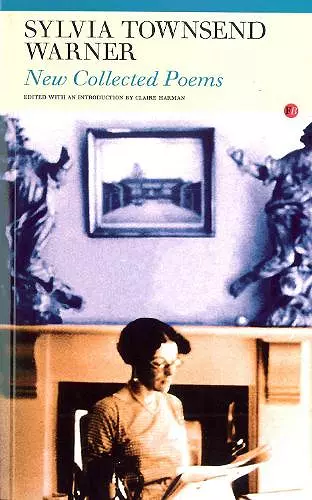
The first Collected Poems of Sylvia Townsend Warner (1893-1978) was published by Carcanet in 1982. Since then, more of her work has come to light, including some of the most moving and personal poems she ever wrote. Claire Harman, the original editor and author of the prize-winning biography of the poet, has substantially revised the earlier edition, including over ninety previously uncollected and unpublished poems, with expanded notes, a chronology and an authoritative new introduction.
When Harman's Life was published, it restored Warner, one critic said, to her real place as 'second only to Virginia Woolf among the women writers of our century'. With this collection, the extent of Warner's achievement as a poet can be appreciated.
With discerning scholarship Claire Harman has edited, selected and annotated both the collected and uncollected work (1925-1980) of an overlooked lyrical and satirical voice. Her introduction, like her award-winning 1990 biography, reveals the life and diverse literary output of Sylvia Townsend Warner, whose prose fiction and verse attracted equal critical interest until she closed her publicised career as a poet after the notorious Whether a Dove or a Seagull (1934). This intertwining of verse (without titles or authorial names) by herself and her lover an fellow poet, Valentine Ackland, was blacklisted less for its movingly expressed (and deftly ignored) lesbian eroticism, than for questioning the mindset that 'judges the poem by the poet rather than the poet by the poem'. A cue for us now, though we'd need to assess Warner's novels, short stories, translations and biographical writing to test the blurb-quoted claim: 'second only to Virginia Woolf among women writers of our century'.
I began by suspecting the aficionados' reinstatement of a writer whose verse was her cherished medium, yet, after one débâcle decided to write primarily for herself. In fact, from her earliest collections, which excel in a kind of sardonic rural and suburban pastoralism, through to her bundled-up, often unsorted final manuscripts, Warner is an assured versifier, not limited to but most adept at intense, terse, tightly rhymed forms. Even where she's too ingenious her expanding array of techniques enhances her tone and remarkably eclectic subject matter. She leaves few stones unturned. But quirky features persist: archaisms and redundant 'poetic' diction, obscure vocabulary dredged up for rhymes, abstract personifications and displaced syntax. In contrast to many well-known contemporary poets echoed in theme and style she is apt either to fail or refuse to marry colloquial energy with formal restraints.
Some of her best work concerns the oppressed and the outsider with implicit reference to agricultural recession and the disruptive impact of war. Where rhetoric is resisted, there are hard-hitting poems from her experience as a Red Cross volunteer and communist sympathiser in the Spanish civil war, and from her civilian observations of war-torn Britain. In 'Benicasim' she captures the contradiction of a colourful, fruitful landscape and war's human toll: '...we have come / into a bright-painted landscape of Acheron. / For along the strand / in bleached cotton pyjamas, on rope-soled tread, / wander the risen-from-the-dead, / the wounded, the maimed, the halt. / Or they lay bare their hazarded flesh to the salt / air, the recaptured sun, / or bather in the tideless sea, or sit fingering the sand.' Valentine and Mr Cox features a graceless working man looking over a bridge to where 'Flickered the dragonfly image of the high-in-air / Bombing plane rehearsing murder overhead, / And the trout poised in the swaying water weed.' Asked how he would react if he heard the war had ended, 'With bloodshot eyes and sunken for lack of sleep / He looked soberly at her and with a deep / Grieving breath sight out his mind. I would weep.'
The love poems evoke the widest ranger of emotions, and a more expansive, experimental style in response to Ackland's freer forms. Where it is not overdone, Warner's brand of the sprung-rhythmic style of Hopkins and Dylan Thomas adds to the sense of conflicting rapture and confusion. I admire her yoking together of diverse objects and areas of experience into dense metaphors; but I return to the more focused poems like this wistful description of her lover on a meery-go-round: '...As, poised on the rise and fall of your varnished grey, / A silence swung on the steam organ's bray, / A secret brandished round to beholders, / And prize, for term of two-pennyworth left to us, / Of my following eyes, and prey, / You float within touch of hand and remote as child at play; / For love of your long legs and your proud shoulders . And the one lappet of hair hanging astray / I would give you Alexander's Bucephalas, / Though you should mount and ride away...'
This is too cursory for a book that amounts to a re-exploration of some crucial trends and developments of 20th century verse. Readers may feel excluded at times, but Warner will win respect and admiration.
Some literary texts, causing scarcely a ripple in the larger tidal survey, excite a turbulence troubling particular readers; a tide-map may change shape subsequently to accommodate the strange object, or the waters again close over what can be deemed a local snag or a reader’s special neurosis. This last can happen time and again; there are books proclaimed as discoveries every other decade, only to sink back out of circulation. Turbulence is endemic to a category such as modernism compromised between a periodic and a stylistic designation, and representing an institutional net of decisions as complicated and as slow to adapt as the Austro-Hungarian bureaucracy of The Man Without Qualities.
But the problems of modernism’s configuration have reached a point where endless fine adjustments exacerbate the category’s contradictions. The institutional panoply sails on, but with twin prows, an ever more stressed catamaran. Straining in one direction is a reassertion of a rigorously defined set of stylistic and epistemological principles. The extension of the core modernist cohort of poets to include Louis Zukofsky and George Oppen exemplifies this tendency, symptomatic of the retrieval of modernism by poets and scholars after postmodernism. Modernism then becomes a stylistic choice in the present, asserting its legitimacy through extending the modernist line towards the point where history or conspiracy is seen as contriving to snap or occlude it.
On the other hand, retrieving submerged writing by women and by gay poets contemporary with high modernism, has had the unanticipated effect of bringing back into currency a range of stylistically un-modernist poetry. Some was written oblivious of modernism, some in deliberate refusal or contestation, but all derives from that same rich conjunction of symbolism, Georgianism and urban-realist balladry where modernist poetry had its English birthplace. Georgian style anticipated the anti-modernist regionalism which has become the poetic mode most favored in contemporary Britain. But another line of un-modernist poetry runs from the early poetry of Yeats, including a predilection for theosophical concoctions and personal mythological pantheons, and represents a principled commitment to poeticism as resistant to commodification, declarative transparency and instrumentalism—a position developed by later poets, particularly women and gay men, including Robert Duncan, John Wieners,and Jennifer Moxley. From this perspective there are poems by Edna St. Vincent Millay as radical as the early poems of Ezra Pound; and Robert Duncan could discover major sources not only in the subsequently canonized modernist H. D. (whose writing has a theosophical strand) but also in the eldrich Lallans ballads of Helen Adam. Such predilections if expressed as a program, might reject the Poundian (and objectivist) emphasis on clarity of particulars, staking all on the prosodic generation of powerful feeling (not necessarily self-expression).
The poetry of Sylvia Townsend Warner belongs to this complicated constellation, where tradition was recreated rather than conserved. Her poetry of a sometimes frank lesbian eroticism and of a distinctly unintellectual communist commitment, works through and against the conventions of Georgian verse. No wonder it outraged Robert Frost more than overt modernism could—for Warner’s poetry is blasphemous in taking the pastoral mode seriously and, to reach for a current usage, in queering the pastoral.
The editor of Warner’s New Collected Poems, Claire Harman, is cautious with claims for the work, and this is fortunate since her understanding of poetics is limited. Noting that in Warner’s drafts 'you can see her quite often changing words for the improvement of the musical effects,' she adds 'this might seem deplorable.' If sensible behavior is her criterion for poetic success, Harman is reading the wrong poet. She does however praise the powerful ambivalence of the Second World War poem 'Recognition'. This point could be extended; Warner’s war poems are uncomfortable, potent, perverse in their use of pastoral, and decidedly feminist:
No will of mine, the pilot
Whispered, from my young wife and from my sleeping
Children to this work
Sent me out, a sower reaping
The curses of women who clutch their babies unsleeping.
This strikes a note familiar from Lynette Roberts's modernist long poem, 'Gods with Stainless Ears,' and taking Warner's lyrics alongside Roberts's fractured narrative leads to the judgement that the finest British poetry of the Second World War was written by women on the home front. Warner’s communism and feminism and Roberts’s Welsh nationalism inoculated them against contrived ideological and emotional unity—which were good for the war effort but not for poetry.
Sylvia Townsend Warner was impossibly erratic. Repeatedly her lyrics offer terrific first and second stanzas, high-wire sentences zig-zagging through formal metrics and rhyme, before a third stanza starts a collapse into embarrassingly arch diction, the whole rounded off with a final stanza so incompetent that it suggests a need to vandalize what could not stay true to a first necessity. Yet Warner could write poems of a prosodic intricacy beyond most of her contemporaries; an early example is 'The Requiem', apoem evidently generated by tight vowel-patterning, and anything but deplorable. Its conventionality is redeemed by its flaunting its artifice. Meanwhile from the start she twisted Georgian motifs like the verse of wayfaring in which W. H. Davies and Robert Louis Stevenson were adept, but gave them a nasty edge in poems like 'The Capricious Lady' and The Dear Girl'; while the lullaby-like 'The Little Death' is disturbingly literal and 'The Possession' is the scary song of an implacable stalker.
Besides these songs and the Second World War poems there are two other notable groups of lyric poetry in Warner’s work. The first consists of poems addressed to her lover Valentine Ackland or addressed to herself in Ackland’s absence. Some are highly erotic and remarkable for the alternating tension and relaxation of the poetic line. The kindling of language and flesh seem one, as in 'Since the first toss of gale blew' with its exquisitely suspended ending: 'What wraths of wild our dangerous peace / Waits to release' and in 'Out of your left eye,' a poem of 'little death' both replete and explosive. Other poems for Ackland are deeply painful, especially the chilling 'Being Watched' where sexual faithlessness blights the kitchen garden; and there are fine poems of settled love, such as “Drawing you, heavy with sleep,” and of love and loss following Ackland’s death, including the beautiful 'I always fold my gloves' and 'Death of Miss Green’s Cottage'. The second notable group consists of poems of advancing age, beginning with a group written in 1950 and culminating in 'Not terror' of 1970. These contrast strikingly with Philip Larkin’s 'Aubade', published in 1977, for the loss of her lover reduces her own anticipated death to mere punctuation for Warner. Although highly personal, the poems are peculiarly selfless. Besides these identifiable groups, several lyrics bracingly displace pastoral convention through their unsentimental view of country labor.
It is good to have this enlarged edition of Sylvia Townsend Warner's poems. These poems can act as a reminder that poetic change does not involve supersession. Writing which once looked old-fashioned can be seen to have affinities with later poetry assigned to the avant-garde. Thinking about the relationship between the 1950s poetry of Robert Duncan and Warner’s extended poem 'Wintry is this April, with endless whine', written at the start of the 1930s, might shed a further welcome obscurity on 'modernism'—as these lines show:
As though a Pentecost hawked down achieving its prey
Of hodden grey,
And earth’s glum looks and true for an instant changed
To the burning fiery furnace where man’s frail dirt
Might stroll unhurt
And talk with angels. Scarcely to be received –
Imposed on sight as meaningless and clear
As etched on ear
Some brief and lovely phrase in a language unknown:
A chance-net as idly trawled over flesh
As the bright mesh
Of bird-song, woven a seamless garment that man
May never shape, piece, suit to his wear or word.
ISBN: 9781857549478
Dimensions: 216mm x 135mm x 30mm
Weight: 517g
408 pages