Mama's Baby, (Papa's Maybe) - New Welsh Short Fiction
Parthian Books author Arthur Smith editor Lewis Davies editor
Format:Paperback
Publisher:Parthian Books
Published:22nd Nov '11
Currently unavailable, and unfortunately no date known when it will be back
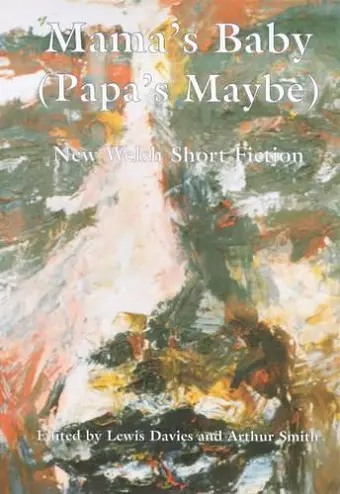
A substantial and diverse anthology of contemporary Welsh prose comprising 55 short stories together with short biographical notes on the contributors. Reprint; first published in 1999.
Mama’s Baby (Papa’s Maybe) contains short stories by some of the best contemporary writers in Wales, and the contents list on the back cover includes both recognisable names and those of lesser-known authors. Collected from submissions to Cambrensis, the short-story magazine founded by one of this anthology’s editors, Arthur Smith, the talent on show is simply superb. The difficult question in reviewing a collection like this (with 55 stories by 55 authors), is where does one start? Well, the common denominator is Wales. All the authors in this collection either live or have lived in Wales, though not all the stories address Welsh life. Some, like George Brinley Evans’s ‘The End of Summer’, are explicitly Welsh and clearly autobiographical. With Brinley Evans, it’s a vivid depiction of life as a teenage miner: a terrifying and clear portrait of what life was like going straight from school to the mines in the 1930s. However, even when stories are not explicitly Welsh in content, there are recurring themes throughout that link this collection, stitching together a patchwork image of twentieth-century Welsh life. Leonora Brito’s title story is a great opener. It is a simple yet sad story that questions notions of identity and the legacy of the generations before us. It feeds in beautifully to Siân Preece’s ‘Running Out’, an excellent story that explicitly questions the reality of what being Welsh means. Brito’s themes of identity are expanded on by Preece, whose protagonist dreams of the Welsh village flooded to create a reservoir to supply water to Liverpool, while working in an ‘authentic’ Welsh restaurant for English tourists. ‘The Welsh costume’s all made up anyway,’ she tells us. ‘Aye, it was all invented by this English woman’. The traditions and pressures of small-town and rural life are well represented here, with a number of authors revisiting their backgrounds and childhoods. Particularly noteworthy are those stories that deal with the pressures of small-town living coupled with religious oppression. John Sam Jones’s ‘The Wonder at Seal Cave’ is a beautifully crafted and restrained story of a young man coming to terms with the truth about who he is amidst the conflicting influences of a strict Methodist upbringing and a modern world. Similarly, Elizabeth Griffiths’s ‘Break Up’ depicts the implosion of family life when the rules and restrictions of religion get too much. While the Welsh themes and lives depicted are a key part of what makes this a collection of ‘new Welsh short fiction’, whether the authors of these stories are Welsh or not is often irrelevant. In Gee Williams’s quirky ‘Waiting for Perestroika’, authenticity and authorship are questioned when a hard-done-by mobile librarian challenges the assumptions of her pulp-romance-reading customers. When they refer to the romantic female novelists whose names adorn the covers of their books, the librarian snaps: ‘All this stuff’s churned out by a bloke called Brian, living in Basingstoke […] a great big scruffy ex-policeman with ginger hair coming out of his nose!’ Essentially, you can read this collection not caring whether the authors are from Cardiff or Cairo, they’re simply good stories. For example, Othniel Smith’s ‘All Boys Seeking Adventure’ is a fantastic mix of dreams and reality combining to perfectly depict a particular point in the life of a young man named Kenneth; while ‘Insufficient Evidence’ has Adam Thomas Jones pinning an entire story on ambiguous decisions, phrases and morals – it’s a real testament to what a good short story can be. These are just two examples out of many more. In his introduction to this collection, Arthur Smith outlines his original statement of aims for Cambrensis. In a long-winded and, as Smith admits, ‘poetically phrased’ statement, the desire is outlined for stories that ‘capture a single moment of truth ... illuminate something of life ... present a new perspective’. I think it’s fair to say that this is achieved. Alun Richards’s ‘Someone Out There’ and Boyd Clack’s ‘The Vanishing Lake’ deserve mention as excellent stories that really do capture that moment of truth; both are haunting snapshots of a people and place now frozen in time. First published in 1999, it would be good to see an updated and not just reprinted edition of this collection, but that is small criticism of what is a great anthology. In Mama’s Baby (Papa’s Maybe), Welsh short fiction has its definitive modern collection. -- Liam Nolan @ www.gwales.com
ISBN: 9781902638034
Dimensions: unknown
Weight: unknown
648 pages