Library of Wales: The Dark Philosophers
Format:Paperback
Publisher:Parthian Books
Published:31st Jan '14
Currently unavailable, our supplier has not provided us a restock date
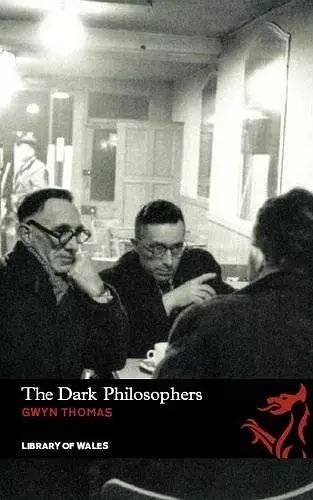
The third title in the landmark series of classics, the Library of Wales. Three novellas distinguished by their astonishing portrayal of incest, murder, and devastating tragic humour. The stories include themes such as sexual and family power, death and exploitation. The final story 'The Dark Philosophers' is a grimly humorous account of three men who gather to discuss revenge.
The Dark Philosophers, Gwyn Thomas's three short novels from 1946,marked the debut of Wales's most original voice...a comic exuberance that echoes Damon Runyon and the Marx Brothers, Karl and Groucho, as he turns the Wales of the 1930s into a Black Book of Goyaesque Caricature and side-splitting Savagery. As he said of his own inimitable work:"It's Chekhov with chips". Dai Smith Series Editor
The Dark Philosophers reappears after a thirty-four year absence as part of the growing Library of Wales.
When first published in 1946 it signalled a belated appearance of Gwyn Thomas who had started writing a decade earlier. Its renewed availability is alongside other titles from those interwar years including Cwmardy and We Live.
Born in 1913, Gwyn Thomas grew into a south Wales ravaged by unemployment, poverty, and a loss of many who might otherwise have sustained the communities they were instead forced to leave behind. Yet what impressed itself onto Gwyn Thomas' mind was a strength of community, empathy and zest for life. His own survival was made possible by way of Barry Grammar School and from there an Oxford college where he found himself looking up, not because he had the slightest respect for the class of students whose presence dominated the place, but because their physical stature was always greater than that of the working class boy from the Valleys. The physical circumstance of his college days seems only to have made his allegiance all the steadier and his appreciation of where he grew up all the keener. Gwyn Thomas began writing in the mid thirties situating his stories in the industrial village so peculiar to south Wales. In this his work joined with others who shared his experience; Lewis Jones (1897-1939), Gwyn Jones (1907-1999) and Jack Jones (1884-1970). Where Gwyn Thomas found his own voice was in a biting comic style allowing his characters to turn anger even bitterness to irony and pathos.
The Dark Philosophers was completed in the late thirties. At the centre are four 'voters' whose worldly wisdom extends to a political awareness that enables them a deep insight into a human predicament. The particular character of that predicament to which their attention is directed is the wretchedness which makes up the world where the great majority of their neighbours live or have lived until removed by authorities that might include the Almighty Lord. The representative of the last is the prime example of another world beyond the Terraces, living instead in a house left to him as reward for turning his pulpit from pedestal for impassioned damnation of wealth and power, to footstool where the powerful could gain assurance that their place was just in a world in need of no more than equanimity and contentment. Those recommended to be content were the poor whose place was one bearable if only it were accepted with piety and meekness. It was this turn from fire raiser to paid apologist that leads our four dark philosophers to a plot that would result in the minister's death. The outcome comes not from direct murder, but beautiful if ice hard instigation and contrasts with a pitiful and hopeless death of a voter with which it is intimately linked.
Gwyn Thomas' characters are recognisable from the Wales in which they are set. The stage on which the four philosophers weekly meet is the back room of a cafe, kept warm by a stove on which is a crest known to be of fascist connection. However when they suggest that the crest be removed, Idemeneo Faracci, to whom the cafe seemingly belongs, is reluctant, for though he has brothers in prison for anti-fascist allegiance back in Italy, a money lender to whom everything in the cafe is owed, is very partial to the crest, and would be upset were it to be filed away.
Our minister meanwhile is a history in himself. A hell raiser whose whole body shook with the need for a great change that would end injustice, sells his soul in hock for his own future when reminded that his pulpit is as much at the disposal of another as is the coal on which the voters stand. Converted, he turns cheek, speaking now of the need to kill more Germans, now of the evil that atheist Bolsheviks inflict on Russia and might yet turn on Gods own Wales. Yet always the constant refrain is of the just balance that places a voter in the trough and another in a place from where they might decide that voter's life.
The Dark Philosophers in no sense exist merely for the need of a story, nor are they separable from the world they inhabit. Rather their humanity, realism, hardness and comedy are part of the fabric which makes writer and character alike. It is though the last of these traits that most readily comes to mind, The Dark Philosophers is a very funny read. Steve Woodhams (Raymond Williams Society Newsletter) -- Publisher: Parthian Books
ISBN: 9781902638829
Dimensions: unknown
Weight: unknown
236 pages