Library of Wales: The Valley, The City, The Village
Format:Paperback
Publisher:Parthian Books
Published:25th Aug '09
Currently unavailable, and unfortunately no date known when it will be back
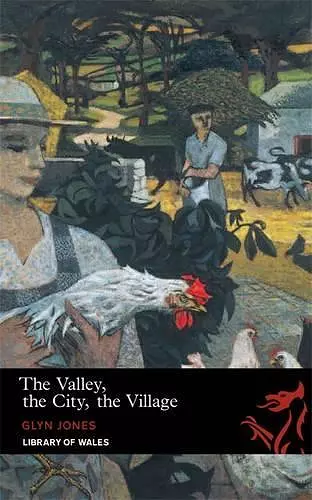
Trystan Morgan's journey through the conflicting cultural, social and political values of his country in the mid-twentieth century is bewildering but finally liberating. And through the glittering, crowded, kaleidoscopic images of this bravura novel, the author creates a rich impression of people and place - a Wales which is a landscape of the mind.
An artist at heart, Trystan Morgan grows up in his grandmother’s valley mining cottage, duty-bound by her deep wish for him to be a preacher. He comes from farming stock and longs to paint the Welsh countryside of his people. But he agrees to study at the city university although his adolescent mind revolts at the social posturing around him.
Trystan’s journey through the conflicting cultural, social and political values of his country in the mid-twentieth century is bewildering but finally liberating. And through the glittering, crowded, kaleidoscopic images of this bravura novel, the author creates a rich impression of people and place; a Wales which is a landscape of the mind.
Glyn Jones was one of the giants of twentieth-century Welsh writing whether as short story writer, critic or poet, and here in his remarkable novel of 1956, he creates a narrative of exceptional power that draws on all these gifts.
******************************************* The Valley, the City, the Village focusies on the artistic and personal journey of Trystan Morgan through the conflicting cultural, social and political values of Wales in the mid-twentieth century. Glyn Jones was one of the major figures of Welsh writing whether as a short story writer, critic or poet, and here in this post-war novel he creates a story that grips with his own personal history. This from the opening of the book: 'Rosser’s Row, to which my grandmother and my Uncle Hughie had brought me to live, was a colliers’ terrace, standing on the bank of the black river oiling down the cwm…. Trefor and I came out of the row and crossed the iron bridge over the river, but we were not going to school because we did not like Knitty Evans. Knitty was our teacher, a bellower and a bull-roarer, always very masterful and intolerant towards us… at the end of every lesson he rose up and came skirmishing amongst the class with his dirty cane, bellowing and bringing bad feelings and oppression, his long black hair displaced and dangling down over his ears like a pair of wings.' -- Publisher: Parthian Books
Although well-known for his short stories and poetry as early as the 1930s, this was Glyn Jones's first novel, published in 1956. It is referred to as a 'fictionalised autobiography' which would suggest that it is set in the first two and a half decades of the twetieth century although its lack of reference to external events like the war and some details of description suggest a blurring of period. Trystan Morgan, the narrator, is not portrayed as a writer but as an artist and this is borne out by the intensely visual, indeed painterly, nature of his account of the world. The first section concerns Trystan's childhood and schooldays in the mining village of Ystrad and nearby Pencwm. This is a rich, lively and affectionate picture of rural life, very comparable to Laurie Lee's Cider with Rosie. Like Lee's, Glyn Jones's poetic ability is evident in the writing and his deep love for his grandmother makes her the presiding presence of the book. In rendering the Welsh life of the valley through English and early childhood awareness through the lexicon of a middle-aged scholar, Jones gives Trystan an extraordinary style and vocabulary; riotously mixing registers, coinings and Welsh words in a completely un-naturalistic way but, by it, achieving tremendous vitality especially in his portrait and landscape painting. The City deals with Trystan's university years at an (unspecified) Welsh university where he had agreed to study a literature and history course to please his grandmother, although he really wished to go to Art College and train as a painter. In fact he is so disappointed and alienated by the university that he secretly attends an Art evening-class where he meets Mabli. The roistering parties and intellectual wranglings of male student life are well depicted while Trystan's naivety gives the account both humour and poignancy. His lack of sexual experience leads him to watch and idolise an unknown girl and then reject her with horror merely on the damning remarks of his more worldly friends. As Trystan is our narrator it is difficult to judge the author's subsequent attitude to this. Trystan fails his degree and retreats to The Village - Llansant. This third section returns to the affectionate fantasy of the first. Jones paints a highly-coloured, Chagal-style picture of this period with two of his college friends staying at the house of his aunts. Joyce's influence is evident, as is that of Jones's friend Dylan Thomas (on whose contradictory personality more than one of the college friends seems to be based). Trystan is working through his conflicting loyalties to his home culture and his deep need to be an artist, and the challenge of a Welsh identity posed by Mabli. The novel culminates in a dream sequence of a 'Last Judgement'. Condemnation of the attitudes of the young men - Gwydion the aesthete's rejection of flawed humankind; Nico's thoughtless sensuality - imply Trystan's choice of a principled, humane life in which his art will affirm the value of all men. The return of his deified grandmother to pronounce judgment brings the novel full circle. While not showing the focus and structural strength of his other writing, this very personal, experimental novel reveals a tremendous linguistic richness and a serious struggle between rival claims in the soul of the artist. -- Caroline Clark @ www.gwales.com
ISBN: 9781906998134
Dimensions: unknown
Weight: unknown
360 pages