Rocking the Boat - Welsh Women Who Championed Equality 1840-1990
Welsh Women Who Championed Equality 1840-1990
Format:Hardback
Publisher:Parthian Books
Published:1st Feb '18
Currently unavailable, our supplier has not provided us a restock date
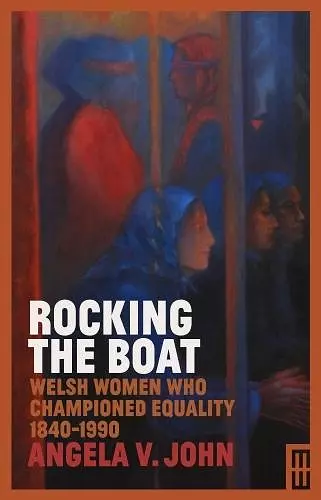
Rocking the Boat will be launch on Women's Day with events across Wales and England.
This insightful and revealing collection of essays focuses on seven Welsh women who, in a range of imaginative ways, resisted the status quo in Wales, England and beyond during the nineteenth and twentieth centuries.This insightful and revealing collection of essays focuses on seven Welsh women who, in a range of imaginative ways, resisted the status quo in Wales, England and beyond during the nineteenth and twentieth centuries.
This insightful and revealing collection of essays focuses on seven Welsh women who, in a range of imaginative ways, resisted the status quo in Wales, England and beyond during the nineteenth and twentieth centuries. Written by an acclaimed biographical historian, the essays not only challenge expectations about how women’s lives were lived in the last two centuries, they also explore different ways of approaching biographical writing and understanding, as well as raising issues of gender and nationality.
From the pioneer doctor and champion of progressive causes, Frances Hoggan, to the irrepressible twentieth-century novelist Menna Gallie, these women spoke out for what they believed in, and sometimes they paid the price. Although proud of their Welsh identity, they articulated it in a variety of ways, and each spent most of their adult lives outside Wales. They became familiar, and often controversial voices, on the page and platform in London, Oxford, Northern Ireland and internationally. Lady Rhondda and Edith Picton-Turbervill championed women’s equality at the centre of power in Westminster, whilst Myvanwy and Olwen Rhŷs saw education as the key to change. Women’s suffrage played a prominent part in the lives of these women and was especially central to Margaret Wynne Nevinson’s thinking, writing and actions.
The intelligence, determination and grit of these women is revealed through their stirring stories. Taken together, the essays critically investigate the challenges, setbacks and hard-won achievements of feisty women who rocked the boat over a period of 150 years.
-- Publisher: Parthian BooksThe year 2018, as everyone must know, marks the centenary of women’s right to vote, albeit in a limited form – you had to be over 30 and either a property occupier or married to one. Full enfranchisement only came ten years later with the Equal Franchise Act of 1928. Rocking the Boat is published, therefore, at an apposite moment, though as the subtitle implies, its brief goes beyond the issue of voting rights. It is in fact a biographical study of seven remarkable Welsh women who made determined and largely successful assaults on various bastions of male power, challenging in the process masculine assumptions about women’s ‘place’ in society, and by implication what it means to be a woman. The women are: Frances Hoggan (1843-1927), Lady Rhondda (1883-1958), Myvanwy Rhŷs (1874-1945) and her sister Olwen Rhŷs (1876-1953), Margaret Wynne Nevinson (1858-1932), Edith Picton-Turberville (1872-1960), and Menna Gallie (1919-90). Many, perhaps most, of these women will not resonate with Welsh readers today because, as Angela John suggests, they lived and campaigned for the most part outside Wales, even though they were Welsh-identifying in varying degrees. All except Menna Gallie were born in the nineteenth century and came from middle-class or gentry backgrounds, and most were well educated, which gave them an advantage in their assault on male-dominated professions and their campaigns for equality. The obstacles were nonetheless formidable. Francis Hoggan, for example, became the first woman in Britain to obtain an MD, but she had to travel to Zürich to obtain it, writing and defending her thesis there in German. Her husband, George Hoggan, also a doctor, supported her search for equality in the medical profession, and together they set up a general practice. She was nonetheless subject to petty vindictiveness on the part of the profession – elected to the British Medical Association, she had her membership withdrawn, after a referendum of the (all male) members decided against admitting women. Undeterred, she did research most notably on the nervous system, and was active in a range of causes, from anti-vivisection, health education, dress reform, the health care of women in India, to education in Wales – and suffrage. In fact, one aspect of all these women whose formative years were spent in Victorian England is how busy they were, joining societies, campaigning for the franchise and also for social and educational reform, attending public meetings, publishing pamphlets and books, travelling widely abroad. The later nineteenth century may have been a time when men in power attempted to keep women down, but it was also a time of social and political ferment when intelligent, educated women were indeed ‘rocking the boat’, helping to create the more equal (at least) world we live in now. (My own mother was born in 1908 when women had no voting rights. In 1929, when she was twenty-one, she was part of the first generation of women with a full franchise. In no small part this was due to the tireless campaigning of women like Margaret Wynne Nevinson and Edith Picton-Turberville.) The range of these women’s interests and their energy in pursuing them is well illustrated in the life of Margaret Haig Thomas, Lady Rhondda, who inherited her title from her father, the wealthy industrialist D. A. Thomas. She founded and edited the influential journal Time and Tide, became the first female president of the Institute of Directors, held numerous directorships, was the first woman president of a Welsh college (University College of South Wales and Monmouthshire), sat on committees connected with health and social reform, and was deeply committed to gender equality. These were remarkable people by any standards, none more so than the Rhŷs sisters, Myvanwy and Olwen, the daughters of Sir John Rhŷs, who held the first Chair of Celtic at Oxford University, and Lady Elspeth Rhŷs. Their parents were suffragists and supporters of liberal causes, including the education of women. Welsh speakers themselves, they brought up their daughters speaking Welsh, as well as French and German. (Typically, when Olwen travelled to Serbia to work on relief at the end of WW1, the first thing she did was learn Serbian.) Myvanwy studied at Cambridge and Olwen at Oxford though neither was allowed to take a degree in that hidebound world – Myvanwy got her degree in Classics recognised at the more enlightened Trinity College, Dublin. The sisters were active suffragists, taught, published, did voluntary work during the War, and were independently and critically minded. They were also not without a sense of satire – staying at the Pioneer Club, while doing research in London, Myvanwy wrote that it was ‘a dismal hole – so dark and full of gushing ladies who love one another.’ Rocking the Boat is the result of deep and wide-ranging scholarship as the numerous end notes attest, but Angela John writes with a refreshing elegance which makes this book a pleasure to read. All of these women deserve to be better known and celebrated in Wales, and this is an excellent place to learn about them. -- John Barnie @ www.gwales
ISBN: 9781912109500
Dimensions: unknown
Weight: unknown
330 pages