Aberfan
A Story of Survival, Love and Community in One of Britain's Worst Disasters
Gaynor Madgwick author Greg Lewis author
Format:Paperback
Publisher:Y Lolfa
Published:10th Jul '26
Should be back in stock very soon
This paperback is available in another edition too:
- Paperback£9.99(9781784612757)
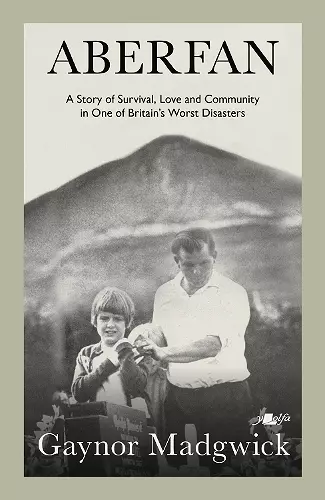
21 October 2026 marks the 60th anniversary of the Aberfan disaster, and as something which caught the attention of the whole world at the time, there will be a lot of attention to the anniversary in the British media.
In 1966, thousands of tons of coal tip waste slid down and crushed Aberfan’s primary school, killing 144 people, including 116 children. Gaynor Madgwick, aged 8, survived. She tells her own story and interviews other people affected. Updated edition to mark the 60th anniversary of the disaster.
On 21 October 1966, thousands of tons of coal tip waste slid down a mountainside and devastated the mining village of Aberfan. The black mass crashed through the local primary school, where pupils were celebrating the last day of term. 144 people were killed – including 116 schoolchildren.
Gaynor Madgwick was there. She was 8 years old and was severely injured. Her brother and sister were in classrooms either side of her. Both were killed.
In Aberfan, Gaynor tells her own story and also speaks to other people affected by that day – from the bereaved and the rescuers, to the police and royalty. She explores the nature of courage, grief and faith, to create both a moving personal story and a definitive account of the events that shook the the world.
Updated new edition to mark the 60th anniversary in 2026 of a disaster that a whole nation mourned.
On 21 October 1966, thousands of tonnes of coal tip waste slid down a mountainside and devastated the mining village of Aberfan. The black mass crashed through the local school, where pupils were celebrating the last day of term. One hundred and forty-four people were killed. One hundred and sixteen were schoolchildren. Gaynor Madgwick was there. She was eight years old and severely injured. Her brother and sister were in classrooms either side of her. Both died. In Aberfan Gaynor tells her own story and interviews people affected by that day – from the bereaved and the rescuers, to the police and royalty. She explores the nature of courage, grief and faith, to create both a moving personal story and a definitive account of the events that shook the nation and the world. -- Publisher: Y Lolfa
This year will be the fiftieth anniversary of the Aberfan disaster. There are some events that are etched so deeply in one’s memory, and as long as you live you will always remember when and where you first heard of them. One of the many poignant photographs reproduced in this book shows the school clock stopping just short of 9.15 am. I was also in school that day, and I distinctly remember our geography master telling us, just before we commenced our 10.00 am class, that there had been a tragic incident at a school in south Wales, and it was feared that many children may have died. We had to wait until the evening news to learn the full extent of the disaster that took place at Aberfan on that Friday morning on 21 October 1966. Its impact was immediate, as it was one of the first televised disasters. Eight-year-old Gaynor Madgwick (née Minnett) was also in school that morning, and this is her remarkable story. She was severely injured, but survived, while her brother Carl and sister Marilyn, in adjacent classrooms, perished. After nearly 50 years, Madgwick has traced a number of people who were involved in varying ways with the events of 1966, and in so doing she has managed to show how this tragedy continues to impact on the lives of so many. This was a disaster that was different to many others in that it involved so many children, and it was also entirely focused on one small community, rather than on a large and random group of people brought together, such as those who are killed by accident or terrorism in an aeroplane. It was also a tragedy which could have been avoided. Among the people Madgwick revisits are a nurse who helped her recover at St. Illtyd’s Hospital in Merthyr, even though she had lost her own daughter at Aberfan. She also met up with a young soldier, James Bullock, whose regiment, based in Devon, was sent to Aberfan to assist with the rescue, and academic Professor Iain McLean, who did so much to assist the residents of Aberfan to overcome the injustices they had suffered at the hands of several governments and the National Coal Board. Lord Snowdon, who visited Aberfan after the disaster and met Madgwick in hospital, is also interviewed in a touching chapter, as is Ron Davies, the former Secretary of State for Wales, who is credited with repaying £150,000 in 1997 to the Aberfan Disaster Fund which had been callously taken to help clear the cost of removing the tips. The medical impact of the disaster is discussed by the local GP, Dr Ramsewak Prasad, who worked alongside his senior colleague, Dr Arthur Jones, who had served the community so well for 48 years. Both of them had to cope with the psychological impact of such an horrendous event on their patients, largely before post-traumatic stress disorder was identified as a medical condition. The spiritual angle is also examined in interviews with June Vaughan, a local preacher, and Irving Penberthy, a Sunday School teacher. Madgwick does not dwell too much on the politics of Aberfan, and this is left largely to an incisive introduction by the veteran broadcaster, Vincent Kane, who leaves us in no doubt where the responsibility lay for the disaster. Thankfully Madgwick has now found happiness after a troubled life, having had to live with the guilt of the survivor for all her life. And writing so sensitively has helped her to come to terms with what happened in 1966. This is certainly not an easy book to read, but as noted by Lord Snowdon, it should and must be read by all of us in memory of those who died, whilst not forgetting those who also survived this tragic event. -- Richard E. Huws @ www.gwales.com
ISBN: 9781912631650
Dimensions: 215mm x 140mm x 20mm
Weight: unknown
2nd edition