Fear of Barbarians
Petar Andonovski author Christina E Kramer translator
Format:Paperback
Publisher:Parthian Books
Published:1st Aug '21
Currently unavailable, our supplier has not provided us a restock date
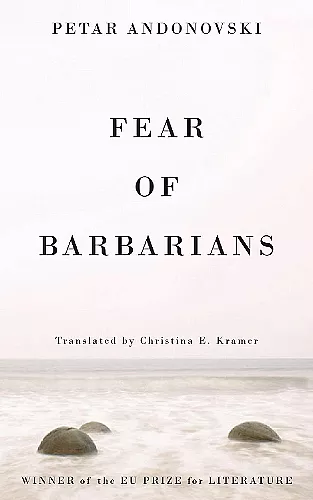
Winner of the 2020 European Union Prize for Literature.
Gavdos: a remote island south of Crete, the southernmost point of Europe, surrounded by an endless expanse of sea. To Oksana, who has come from Ukraine with her friends to recover from illness in the aftermath of Chernobyl, it seems like a dream to live in a blue-and-white house with a lemon tree. To Penelope, a Greek woman, it is a kind ofTranslated by Christina E. Kramer Gavdos: a remote island south of Crete, the southernmost point of Europe, surrounded by an endless expanse of sea. To Oksana, who has come from Ukraine with her friends to recover from illness in the aftermath of Chernobyl, it seems like a dream to live in a blue-and-white house with a lemon tree. To Penelope, a Greek woman who was married off to an unsuitable man by nuns from the convent where she spent her teenage years, it is a kind of prison. Their two narratives, interwoven with other stories - of the other women of the sparse community, of their own past lives and loves - are skilfully combined with themes of otherness and the notions of 'foreign' and 'barbaric' in this poetic and timely short novel by acclaimed Macedonian writer Petar Andonovski, winner of the European Union Prize for Literature. Translated from Macedonian
Barbarians, the ultimate other, the extrinsic threat invading the interior – be that interior a border, a home, or a sense of self. As a word, it serves to define the ultimate other, that which lacks all the hallmarks of civilization, of true or genuine humanity. In this award-winning novella, Petar Andonovski explores with deftness what it means to be otherized. The narrative primarily follows Oksana, who is recovering from an illness contracted in the aftermath of Chernobyl, and Penelope, a Greek woman forced into marrying a cold and difficult man. Neither are from Gavdos, the island on which the novel is set. They are perceived as threats: Oksana treated as a living embodiment of nuclear anxiety, Penelope as a peculiar intruder who has staked an ambitious claim upon the land by marrying one of its men. Far from affirming this rigid sense of community and social hierarchy, Andonovski portrays it as proof of something gone horribly wrong. Albino twins Kiki and Aliki are also treated as potentially dangerous, despite being born on the island. This fear is not really about protecting a border or community, it is about making each of your neighbours a reflection of yourself. It is about shrinking from difference. It is not the women who have corrupted Gavdos, but the distillation of socio-political narratives into crude prejudices. So, the fear of barbarians is presented as something foolish, unfounded, and inflammatory. But on the other hand, the reader is presented with the rich internal lives of Penelope and Oksana, which are depicted as immensely private and delicate. For both women, having been taken to a new place without any say in the matter, it is memory which offers the last dregs of freedom they can enjoy. Their loneliness, which is of course primarily very saddening, also protects their sense of personhood. Their minds, and this is in sharp contrast to the rest of the people on the island, are their own. This is a book which announces itself as an offspring of the western literary canon. Penelope takes her name from Odysseus’s wife in The Odyssey, and both women wait for loves that seem to have disappeared, desperately trying to stay loyal and faithful. Odysseus Elytis and Constantine P. Cavafy are both quoted, and the epigraph is taken from the Book of Isaiah. Perhaps, under the weight of such prestigious material, the story is slightly crushed. However, Andonovski deserves eternal credit for the courage and intellect to craft such a subtle story from these materials. Fear of Barbarians is an enjoyable, short read that depicts with subtle intelligence the difficulties of arriving into and living in a small community. It is beautifully peculiar, and a good read for anyone desiring fiction that is just a little odder than the norm. -- Alex Hubbard @ www.gwales.com
- Winner of European Union Prize for Literature 2020
ISBN: 9781913640194
Dimensions: unknown
Weight: unknown
94 pages