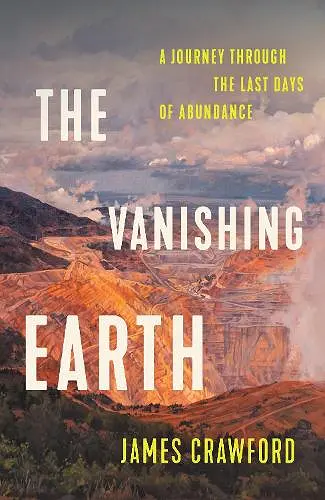
The Vanishing Earth
A Journey Through the Last Days of Abundance
Format:Hardback
Publisher:Scribe Publications
Published:10th Sep '26
Should be back in stock very soon
‘You will never look at sand, food, phones, or concrete the same way after reading this book. A touching exploration of the dark underbelly of our modern world and how we can move beyond it.’ Luke Kemp, author of Goliath’s Curse
‘Crawford belongs with other storyteller-explorers — strolling player-writers like Iain Sinclair, Rebecca Solnit, and Robert Macfarlane — who are stretching naturalist observation into incisive cultural inquiry ... Riveting.’ New York Review of Books
A deeply reported journey into the scarred landscapes of global extraction — and a search for the path to repair.
Humanity has remade the Earth with astonishing speed. In the last fifty years alone we have taken more out of the planet than in all prior history combined. Everything we touch ― rock, metal, sand, water, even thought itself ― feeds the pursuit of limitless economic growth.
Born into a family and a Scottish landscape steeped in fossil fuels, James Crawford travels through the living ruins of extraction and meets the people living within its extremes: exploring the radioactive fertiliser-ziggurats of Florida’s Bone Valley, the lithium flats of the Atacama, Greenland’s collapsing melt-edge, the desertified shores of Spain’s Sea of Plastic, and the resource-hungry cloud centres birthing new artificial intelligences, to expose the true cost of this hollowed-out dream.
Yet within these same landscapes lie radical alternatives. Hope emerges in the communities waging legal battles to leave oil untouched beneath the rainforests of Ecuador and the wildfire-stricken plains of Montana; technologists attempting to reverse extraction on Iceland’s tundra; and architects raising wooden skyscrapers amid Scandinavia’s felled forests ― finding the path to repair for a world pushed to the brink.
Incisive, immersive, and visionary, The Vanishing Earth exposes the ideological forces that have shaped the planet and charts the essential pathways that could yet save it.
‘Crawford belongs with other storyteller-explorers — strolling player-writers like Iain Sinclair, Rebecca Solnit, and Robert Macfarlane — who are stretching naturalist observation into incisive cultural inquiry ... Riveting.’
* New York Review of Books *‘Beautifully written, surprising, and (dare I say it) important, The Vanishing Earth explores the ragged edges and obscure interiors of capitalism’s relentlessly expanding territory and asks how we can stop commodifying and consuming everything from sand to our own minds before it really is too late. This book is worth your time and attention.’
-- Adam Welz, author of The End of Eden‘The Vanishing Earth is an astounding achievement, and the best account I’ve yet read of the modern pathology of extraction. It’s accessible and rigorous, ranging across continents and decades, and alternately chilling, terrifying, and infuriating, particularly in its lucid demonstration of the foreknowledge of the oil and gas giants and the historic and ongoing denialism of the economic and political mainstream. Crawford expertly guides us across an impressive range of material and actors, in prose that’s both elegant and gripping. It’s a vital, bracing synthesis, rousing and clear-sighted, and one that’s ultimately not without hope, in its belief that the world can be repaired and remade.’
-- Martin MacInnes, Booker-nominated author of In Ascension‘Crawford travels around the world examining the escalating catastrophic havoc perpetrated on the planet’s biogeochemical integrity in terms of land and natural cycles … A compelling call for urgent action.’
* Booklist *‘Historian and journalist Crawford takes readers on “a journey to the literal and ideological frontiers of extraction” in this sweeping account of the toll the pursuit of endless economic growth has taken on the planet ... a dizzying feat of reporting.’
* Publisher’s Weekly, starred review *‘In The Vanishing Earth, James Crawford travels beyond the physical frontiers of a planet consuming itself into the human psyche, where the harvesting of thought, attention, emotions, and neural data represents represents the latest, and most intimate, form of extraction. The Vanishing Earth is urgent and immersive. Crawford asks not just what we are losing but why we can’t stop.’
-- Greg Grandin, winner of the Pulitzer and National Book Awards for Non-fiction‘Urgent, illuminating, and deeply unsettling, The Vanishing Earth forces us to confront a stark question: if the logic of extraction is driving us toward planetary collapse, what kind of society must we build to escape it?’
-- Kohei Saito, internationally bestselling author of Slow Down‘You will never look at sand, food, phones, or concrete the same way after reading this book. A touching exploration of the dark underbelly of our modern world and how we can move beyond it.’
-- Luke Kemp, author of Goliath’s Curse‘In the spirit of poetic observer-writers like Robert Macfarlane and Barry Lopez, Crawford — who was born into a family of oil men (his engineer father worked on pipelines, and festooned the walls of the family home in the Scottish Highlands with photos of oil rigs and platforms) — visits five landscapes, including lithium mines in Chile and Florida’s phosphate fields, to trace the history and limits of resource extraction and to learn about emerging, sometimes radical, alternatives.’
-- Emily Donaldson * The Globe and Mail *‘The Vanishing Earth is an intrepid, poetic exploration of our planet’s fast-diminishing natural wealth and the colossal systems we’ve engineered to extract and distribute it. James Crawford’s deep investigation of the Anthropocene’s discontents will leave you awestruck by human ingenuity and hubris — and equally astonished by our species’ shortsightedness.’
-- Ben Goldfarb, award-winning environmental journalist and author of Crossings‘The best books leave readers with facts they didn't know. The rare ones leave them with ideas they cannot stop testing against experience. Since finishing The Vanishing Earth, it has become difficult to watch a corporate merger, scroll through social media, read about artificial intelligence, or hear the language of “human resources” without wondering whether another form of extraction is taking place. Crawford gives readers a new lens through which to see the modern world. Once you’ve looked through it, it's surprisingly difficult to look away.’
-- Philip Martin * Arkansas Democrat Gazette *‘Reveries of natural wonder buoy The Vanishing Earth, a consummate exposé of the pumping, blasting, stripping, felling, and leaching of what remains of the material planet … timely and profound … The Vanishing Earth is essential reading for anyone who might carry a cellphone, purchase a car, heat a home, sip water, or vote on data-centre zoning. In it, James Crawford brilliantly lays bare the landscapes we have riven to extract their treasures and the wonders remaining in urgent need of rescue.’
-- Julie Dunlap * Washington Independent Review of Books *‘It might all be unbearably grim were it not for Crawford’s skilful and lucid evocation of the scientific, historical, economic, and environmental big picture while never losing sight of the individual and existential dimension of his tale.’
-- Fiona Capp * The Sydney Morning Herald *‘More relevant than ever ... Despite its gritty subject, The Vanishing Earth is poetically written. And it ends in hope.’
-- Jeevan Vasagar * The Observer *‘Straight-talking clarity ... Challenging and unpatronising’
-- Stuart Kelly * The Scotsman *Praise for The Edge of the Plain:
‘Searching, generous, and stirringly written … [Crawford inscribes] a palimpsest of associations across time with his impressive command of different disciplines (history, geology, cybernetics, ecology, biology), moving skillfully from surveying the scene of a border to the meanings it holds for those on either side of it. Crawford belongs with other storyteller-explorers — strolling player-writers like Iain Sinclair, Rebecca Solnit, and Robert Macfarlane — who are stretching naturalist observation into incisive cultural inquiry.… Riveting.’
-- Marina Warner * New York Review of Books *Praise for The Edge of the Plain:
‘A lyrical tour of borders in the past and the present … Crawford is at his best when surrendering to his propensity for reverie, an irrepressible, almost romantic sense of wonder that drives the reader from chapter to chapter.’
-- Kanishk Tharoor * Washington Post *Praise for The Edge of the Plain:
‘An innovative and eclectic study of borders past, present, and future … Throughout, [Crawford] draws fascinating and original parallels between historical events … This is a vital and eloquent reminder that borders control ‘our landscapes, our memories, our identities.’
-- Publishers Weekly, starred reviewPraise for Fallen Glory:
‘No one can accuse Fallen Glory of lacking ambition … It’s a narrative that spans seven millennia, five continents and even reaches into cyberspace. At over 600 pages with endnotes, it’s a commitment. I savoured each page.’
-- Henry Petroski * The Wall Street Journal *Praise for Fallen Glory:
‘Witty and memorable … moving as well as myth-busting.’
-- Mary Beard * Times Literary Supplement *Praise for Fallen Glory:
‘This is a magnificent study of buildings and other structures that have disappeared. Crawford writes beautifully and tells a fascinating tale that embraces the Library of Alexandria, the Berlin Wall and, in the virtual world, the now defunct Geocities. A lovely, wise book.’
-- Alexander McCall Smith * New StatesmISBN: 9781917189590
Dimensions: 234mm x 153mm x 36mm
Weight: unknown
448 pages