The Palace of Wisdom
Format:Paperback
Publisher:Hawkwood Books
Published:16th Oct '26
Should be back in stock very soon
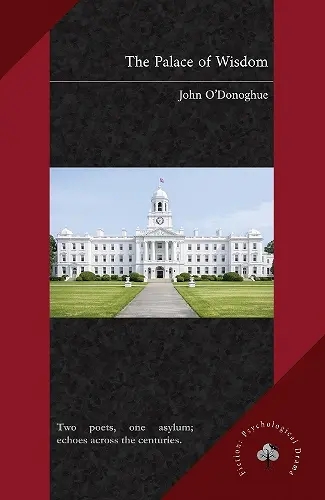
John Clare's and Robert's Lowell's incarcerations in the Northampton Lunatic Asylum unfold in alternate chapters that track their attempts to navigate confinement, forge alliances, and understand the dangers around them. Clare petitions for release while pretending to be various boxers. His secret memoir falls into Lowell's hands and Lowell understands the nature of the evil Clare faced, and which has resurfaced in his own time. With fellow patient Sarah Baxter he gathers evidence against a violent nurse whose actions echo events from Clare's era. Clare dies, finding a final moment of peace; Lowell is discharged to face an uncertain future.
"A fine /and memorable novel. Its two famous, incarcerated poets call across the years to each other and to us a plangent song of loss, justice, and recovery." Adam Foulds
"John O'Donoghue eavesdrops on the voices of those no longer sure who or when they are, echoing down the asylum centuries. An arresting work of commendable insight and empathy from a writer of impressive ability and ambition. A madhouse seance and a divinatory triumph." Alan Moore
"The powerful story of two famous poets confined to the same mental institution a century or more apart. Moving, disturbing, insightful." Blake Morrison
"Here is a generous opening of self to the angels of history. Through genetic possession by conjoined but divided poets, John O'Donoghue charts the bitter geography of incarceration. His swift-moving narrative sources and ventriloquises the subtle confessions of Northampton's embedded ghosts. A crafted and seductive performance. Highly recommended." Iain Sinclair
I came to The Palace of Wisdom with little knowledge of the poets Robert Lowell and John Clare, whose dual narratives comprise this novel. I resisted the temptation to go to my anthologies or Wikipedia to check their life stories and work, and to read the novel as any reader might – that is, as a poetry-adjacent historical thriller. What is known is that John Clare, the ‘peasant poet’, was an inmate of the Northampton Lunatic Asylum, his narrative beginning in 1842. The novel places Lowell in the same institution for a short period in 1976 (although by then it has been renamed St Andrew’s).
O’Donoghue inhabits each poet’s voice in alternating chapters. The voices are convincing and the way the two stories weave together skilful and compelling. It is not only the differing use of language from the two eras that stand out, but also that Clare’s chapters are written entirely without punctuation. The reason becomes apparent in a later chapter: ‘I insist on an end of grammar and punctuation for language cannot be enclosed just as the same as the commons and poor lunaticks cannot be enclosed’ (p.143).
Many an artist has spent time in psychiatric institutions and, though the two timelines are marked by different attitudes to treatment of the mentally ill, there are many parallels; not least the presence of attendants whose motives for working with vulnerable people are far from benevolent. To expand on this without spoilers is difficult, but in each timeline there are characters with similar motives (and, indeed, the same names) and there are also similarly suspicious deaths. The power and effects of institutions on both the inmates and those who guard them is evident. Rapes and assaults go unreported, the patients holding little power, the brutality of the perpetrators allowed to continue.
The heart of this novel is a murder mystery in which the setting is all important. Lowell’s stay in St Andrews is brief, with the action taking place alongside the ‘atmosphere of indolence only asylums can produce, the torpor of the bored, the medicated, the depressed.’ (Lowell’s narrative, p.113). Clare, by contrast, spends decades of his life in the asylum, in fact until his death. Lowell’s days include a poetry group and group therapy. Lowell is called ‘Professor’ by the staff. Clare, however, is patronised by a visitor who describes his poetry as ‘quite charming I am glad you can amuse yourself by writing’. Clare’s response is ‘she had as little conception of the role of poetry in my life than had any of the attendants in this pot of misery’ (p.200).
One wonders whether the different social standings of the two poets has a bearing on their treatment. Lowell mentions previous admissions to an institution in the States. His manic episodes are regarded as temporary, and in between he returns to his life as an academic. Clare, from more humble origins, is considered a permanent case for treatment. He has mixed with the great and the good but is no more a part of their world than he is of the world he was born into. His connections and standing do not allow him to return to the outside world. Does this reflect the attitudes of the time or the trappings of his class? In either case, his only respite is during a failed attempt to escape, and another afternoon of freedom where he slips away to post a letter to the Alleged Lunatics Friends Society to petition for his release. During the latter episode, Clare enjoys a trip to the pub The Bantam Cock, and some time in his beloved natural world.
The liminal spaces between dreams, hallucinations, and reality fog the narratives. Lowell speaks of ‘John Clare haunting me in the hospital,’ (p.196) while Clare’s thoughts and memories of mixing with the aristocratic literati, and of formerly being a prize fighter, leave the reader unclear of which of these is real or delusional. Clare, at one stage, refers to these beliefs as ‘play acting’.
To further cloud the reader’s perceptions, there is not only the filter of the mentally disturbed narrators, but the suggestion of the supernatural at work. Lowell appears to be the more reliable narrator, but he has dreams and visions of Clare’s world and indeed sees the figure of Clare himself.
O’Donoghue is a fine poet as well as a novelist. His inhabitation of Lowell and Clare extends to producing poems in their style at the end of the novel, each purporting to be written during their stays in the asylum. This reviewer has read, indeed reviewed, some of O’Donoghue’s previous books, including his memoir Sectioned: A Life Interrupted. O’Donoghue’s knowledge of mental health institutions is from personal experience, the earliest of which was during the same period as Lowell’s supposed incarceration at St Andrews. The Palace of Wisdom is a fine novel, not only as a murder mystery but also as tribute to the lives of the two poets, and an informed account of lives within the mental health system.
Maria C. McCarthy London Grip Poetry. Maria is the author of Learning to be Irish
ISBN: 9781919474526
Dimensions: unknown
Weight: unknown
240 pages