Beloved Son Felix
Coming of Age in the Renaissance
Format:Paperback
Publisher:McNally Jackson Books
Published:16th Apr '26
Should be back in stock very soon
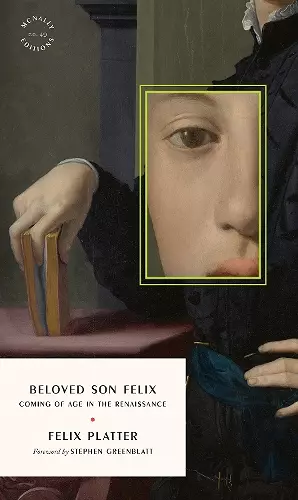
“Like the diary of Samuel Pepys or the memoirs of François-René de Chateaubriand, Beloved Son Felix [is] an invaluable and entertaining firsthand exploration of a bygone era . . . We are allowed a rare glimpse into the street-level experiences of a common Renaissance man.” —Michael Patrick Brady, The Wall Street Journal
The wildly vivid, rare, and revealing journals of a sixteenth-century medical student.
In 1552, sixteen-year-old Felix Platter left Basel, Switzerland, and journeyed 370 miles to Montpelier, France to study medicine. His journals chronicle five astonishing years of youth in a time of plague, war, and awakening. A Protestant in a Catholic kingdom, Felix witnessed blood-chilling executions and engaged in secret religious discussions with his landlord, a Marrano Jew. He learned to play the lute, tasted olive oil for the first time, and swam in the sea. He flirted (unsuccessfully) and danced (disastrously), fled from highway robbers, saw John Calvin preach, survived an outbreak of the bubonic plague, joined in a massive, orange-throwing food fight, acquired a dog, and spent one Christmas Eve alone and afraid of the dark.
Most astonishing of all, he wrote it down.
As Stephen Greenblatt writes in his introduction to this new edition, “Keeping diaries and writing autobiographies did not become a widespread practice until the mid-seventeenth century”—but Felix created an astonishing document: an intimate, sometimes hilarious chronicle of Renaissance adolescence from the inside, whose “vividness, intimacy, candor, and charm” lend it an “altogether rare and revealing character.”
“The diary of the sixteenth-century physician Felix Platter is without precedent in early modern literature . . . Felix Platter is a most lovable and particular boy . . . The real revelations, here and elsewhere, are sensory and psychological . . . It is exceedingly rare to know what happened to a particular person on a particular day nearly five hundred years ago. Rarer still is to know how they felt.”
—Catherine Nicholson, New York Review of Books
“Like the diary of Samuel Pepys or the memoirs of François-René de Chateaubriand, Beloved Son Felix, first published in 1840, is an invaluable and entertaining firsthand exploration of a bygone era . . . Through him, we are allowed a rare glimpse into the street-level experiences of a common Renaissance man . . . Though an ordinary man, Felix lived in extraordinary times . . . And thanks to his keen eye and meticulous attention to detail, we’re granted the privilege of sharing these rich, formative experiences with him—at a comfortable remove.”
—Michael Patrick Brady, The Wall Street Journal
“Reading Beloved Son Felix feels like peeping through a forgotten keyhole into the sixteenth century . . . What a strange comfort it is to read of this long-dead man’s soggy pillows, his heartaches and stomachaches, the terrace with a view of the sea where he liked to study; to know that he enjoyed a good mackerel and a pair of green leather breeches, that he once tripped over his spurs and nearly fell down a flight of stairs, and that his father was so sad to bid him farewell that he couldn’t get the words out. Life seeps out of Platter’s diary in the most unexpected places . . . This is why historians adore primary sources. These are the things we’re meant to remember.”
—Dan Piepenbring, Harper’s Magazine
“In recalling the scenes of his youth, he did something extraordinary: he set aside his years of experience and knowledge of the world and recovered what it felt like to be a naïve, untested teenager venturing out into unfamiliar and often dangerous territory . . . The result reflects rare gifts of inexhaustible curiosity, sharp intelligence, and a canny eye for detail.”
—Stephen Greenblatt, from the Foreword
“This book gives a rare glimpse into the life of a teenage medical student in 16th century France. His diaries detail his interest in anatomy (leading to some grave-robbing), his navigating the complicated religious landscape, and his day-to-day relationship with friends, plus meeting girls. He comes through as intelligent, observant and kind – a wonderful guide to a chaotic and frightening time period.”
—Suzanne Morgan, Politics and Prose (Washington, DC)
“Beloved Son Felix: Coming of Age in the Renaissance compiles Felix’s meticulous documentation of some five years of his life in the sixteenth century as a medical student, Protestant, and capital-P Person in a country marred by religious persecution and plague . . . This gorgeous reissue from McNally Editions features illustrations from Platter’s own diaries along with woodcuts by the Swiss-German artist Jost Amman . . . Felix’s keen eye for beauty keeps one teetering between the sublime and the gruesome . . . Felix renders his surroundings with pointillistic pleasure.”
—Luke Gair, The Sewanee Review, Staff Picks
“As delightful to the ordinary reader as it is useful to the social historian . . . A translation which perfectly captures the freshness and character of the original.”
—C. V. Wedgwood, Sunday Times
“A lively glimpse of a slice of sixteenth-century European life . . . The work does give some nice insight into life in those times, as well as Platter’s character. He plays the lute, goes to dances, and is perhaps a bit of a dandy . . . Beloved Son Felix [offers] a nice and quite far-ranging slice and tour of life in those times . . . It all makes a fun (and sometimes grisly) tour of the times.”
—Michael Orthofer, The Complete Review
“An excellent English translation . . . the well-chosen illustrations, which include a number of drawings by Jennett and two portraits of Platter, add to its attractiveness.”
—W. T. Stearn, The British Journal for the History of Science
“One of the earliest travel diaries of its kind and surely one of the most truthful. It is also one of the most interesting, its only fault being that it is too short. It has now been admirably translated into English in its entirety.”
—Geoffrey Keynes, Journal of the Royal Society of Arts
“An honest diary gives a vivid picture of contemporary life. This book is such a record . . . His plain narrative delineates the cruel customs of the time.”
—Zachary Cope, The British Medical Journal
ISBN: 9781961341685
Dimensions: unknown
Weight: unknown
176 pages