Women and Work Through a Comparative Lens
Gender and the Urban Labor Markets of Premodern Brabant and Biscay
Format:Paperback
Publisher:Leuven University Press
Published:1st Dec '25
Currently unavailable, and unfortunately no date known when it will be back
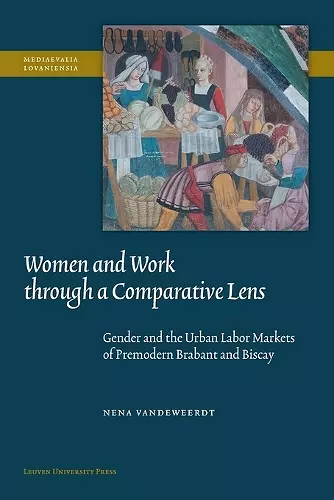
Urban Markets and Women’s Labor: Navigating Institutional Boundaries in Premodern Europe
Women played a crucial role in medieval and early modern urban economies, yet their labor opportunities varied greatly depending on local institutions. This book compares the guild-structured labor markets of Antwerp and Mechelen in Brabant with Bilbao’s informal economy in Biscay during the fifteenth and sixteenth centuries. By analyzing these distinct institutional contexts, it offers a multifaceted understanding of women’s economic roles in premodern Europe. Drawing on a wide range of legislative and judicial sources, Vandeweerdt demonstrates how legal frameworks, socioeconomic structures, and individual strategies shaped women’s activities in small-scale trade. Bridging institutional analysis and personal agency, Women and Work through a Comparative Lens sheds new light on the interplay between labor organization and everyday practices in premodern Europe.
The book’s strength is its careful examination of the institutional structures that allowed or restricted women’s access to trade in each setting; in particular, the author exposes how guilds in the southern Netherlands helped determine women’s roles as distributors and producers, thus providing a clear contrast with the situation in Bilbao. This is a valuable contribution to the growing empirical literature concerning women’s work in premodern Europe. - Martha C. Howell, Columbia University
Nena Vandeveert’s study of women’s work in Brabant and Biscay exemplifies the benefits of a comparative approach. This deeply researched volume teases out the multiple forces that impacted women’s work, and offers a nuanced analysis of how institutions (or their absence) and cultural norms in patriarchal societies worked in tandem to constrain women’s participation in local economies. Significantly, this book compliments a growing body of scholarship challenging the longstanding assertion that women in Northern and Southern Europe had markedly different economic opportunities. This close reading of municipal ordinances, court records, and guild membership lists proposes a fresh look at the economic opportunities available to women workers and the various mechanisms that worked to limit those opportunities. - Susan McDonough, University of Maryland, Baltimore County
Vandeweerdt makes an important contribution to the study of women's labor by contrasting urban economic structures in premodern northern Iberia and Belgium. Offering a complex study of lower-class and middling level women's involvement in labor markets, she makes visible women's contributions to small-scale trade and production, especially in informal markets. Her study underscores how premodern women employed a variety of strategies to safeguard their income and could even influence and shape the very regulations that attempted to limit their economic activities. - Michelle Armstrong-Partida, Emory University
ISBN: 9789462704947
Dimensions: unknown
Weight: 454g
250 pages