Mussolini's Ghost
The Afterlife of a Dictator
Format:Hardback
Publisher:Oxford University Press
Publishing:27th Aug '26
£25.00
This title is due to be published on 27th August, and will be despatched as soon as possible.
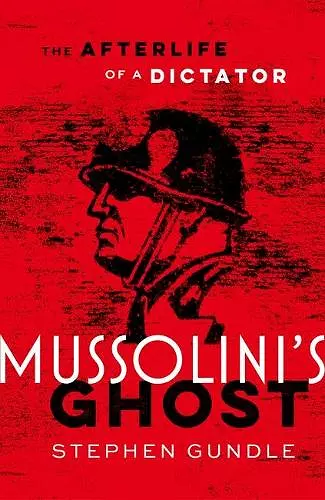
The Italian Fascist dictator Mussolini was killed in 1945 and his body was exhibited upside down in Milan before an angry crowd. The repudiation of the dictator who had led his people to disaster was complete. But his story did not end there. The Duce lived on thanks to a multifaceted and complex legacy. He remained a constant topic of interest due to the activism of his widow and the work of the mass media. He symbolised deeply-rooted ideas about masculinity, national identity and political leadership. His image was embedded in various ways in the physical environment. He haunted the postwar republic after having dominated the political landscape in life. In Mussolini's Ghost Stephen Gundle explores the many aspects of Mussolini's strange afterlife, be it through the fate of his statues and the places that Mussolini was most associated with, his depiction in film and television, his impact on political life, his treatment in public history and his place in popular culture. Gundle argues that the root causes of Il Duce's disturbing persistence lie in the way Italians negotiated the transition from war to peace and from Fascism to democracy. Instead of acknowledging the enthusiastic backing many had given to a criminal dictatorship, many Italians behaved as though Fascism had never really existed. The dictator was instead re-cast as a flawed but well-meaning family man. Thanks to this and other strange reconfigurations, the grip Mussolini established over the popular mind was never properly dismantled. Gundle employs tools of collective psychology to develop a bold new interpretation of the causes of Mussolini's posthumous endurance that makes comparisons with the situation in West Germany.
Mussolini's Ghost is a tour de force in the history of cultural memory and collective psychology. Through innovative exploration of written and visual sources, memorabilia, artifacts and physical places, Stephen Gundle reveals the ways in which Mussolini's cult resonated in the post-war decades, while guiding the reader through the complex intricacy of aftermaths more generally. * Claudia Baldoli, Italian Fascism, 1914-1945: Themes and Interpretations *
Benito Mussolini died in April 1945, shot by Communist partisans and famously hung from his feet from a garage in Milan. But, as this fascinating book shows, he lived on in Italy in so many ways, haunting the country and continuing to provoke debate, but also books, plays, imaginary trials, artworks and numerous other cultural engagements. Stephen Gundle's original and brilliant study unpicks the way that Mussolini has continued to inspire love and hatred, in troubling but also extraordinary ways - from the serious to the absurd. Based on deep and creative research this book will change the way we see the impact and understanding of Italian fascism, and its afterlives. * John Foot, Professor of Modern Italian History, University of Bristol *
Delving into the psychological legacy of the 1930's cult of the Duce, Gundle gives us a vivid, perceptive, and convincing explanation of why, almost 100 years on, the ghost of Mussolini still haunts the contemporary political scene in Italy. Arguing that Italy has failed to come to terms with its fascist past, he helps us understand why, despite the disaster of World War II, the fascist leader still retains his fascination for many Italians. Moreover, in confronting the complex relationship between past and present, this study invites us to reflect seriously on the broader question of the formation and role of memory itself. * Paul Corner, author of Mussolini in Myth and Memory *
Over the course of two decades of Fascist dictatorship, the figure of Benito Mussolini exerted a profound emotional and psychological grip on Italy. His hasty execution on the shores of Lake Como in April 1945, and the desecration of his lifeless form in Milan's Piazzale Loreto just afterwards, were never going to be enough to break the Duce's spell. Stephen's Gundle's fascinating and elegantly written study draws on an astonishing range of sources to account for Italians' enduring obsession with Mussolini, and their simultaneous inability to stage a collective reckoning with the hold that he had over them. Gundle's analysis is subtle, profound and utterly absorbing. This is a book destined to be a landmark in our understanding of Fascism's insidious legacy. * John Dickie, The Craft: How the Freemasons made the modern world *
ISBN: 9780198805908
Dimensions: 240mm x 162mm x 30mm
Weight: 594g
352 pages