The Polish Exile
Chabad Hasidism in the Interwar Years
Format:Paperback
Publisher:McGill-Queen's University Press
Publishing:6th Oct '26
£31.00
This title is due to be published on 6th October, and will be despatched as soon as possible.
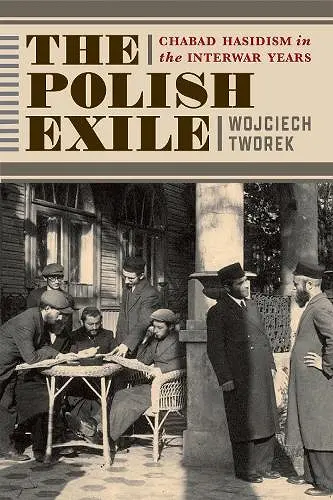
Hasidism, a vibrant Jewish mystical movement, emerged in Eastern Europe in the eighteenth century. Among its branches, Chabad took root and flourished in tsarist Russia, radiating its distinct intellectual and spiritual approach from the Russian town of Lubavitch. But World War I, the October Revolution, and the rise of the Soviet regime shattered the Chabad community and forced its leader, Rebbe Yosef Yitshak Schneersohn, into exile – first to Latvia and later to Poland, home to Europe’s largest Jewish population at the time.
While Poland appeared to offer a stable refuge and fertile grounds for rebuilding Chabad’s institutional and religious foundations, the movement soon confronted a series of profound challenges: shifting internal political conditions, fierce competition within the Jewish communal sphere, and rapidly evolving social realities. Drawing on an exceptional range of Hebrew, Yiddish, Polish, and Russian archival sources, Wojciech Tworek explores how these pressures forced Chabad to adapt and redefine itself within the context of modernity. He traces Chabad’s mystical teachings, literary production, institutional expansion, and evolving ritual life during the interwar years, demonstrating how amid a turbulent era of displacement and reinvention its leadership strategically reinterpreted – and at times recast – the movement’s past. In doing so, it laid the groundwork for Chabad’s postwar messianic orientation, its global outreach, and the emergence of an increasingly influential form of Orthodox fundamentalism.
The first full account of Chabad’s interwar transformation, The Polish Exile fills a vital gap in the study of Jewish history and religion.
“This remarkable work twins a close attention to Hasidic literatures both new and old with an examination of the processes of urbanization, institution-building, and politicization. The result is a must-read for anyone interested in Hasidic life in interwar Poland and, more broadly, for those curious about the complicated ways religious communities have navigated modernity.” - Ariel Evan Mayse, Stanford University
ISBN: 9780228028789
Dimensions: unknown
Weight: unknown
396 pages