Diplomacy and Disregard
The Hungarian Revolution and the United Nations 1956–1963
Format:Paperback
Publisher:Indiana University Press
Published:6th Jan '26
Should be back in stock very soon
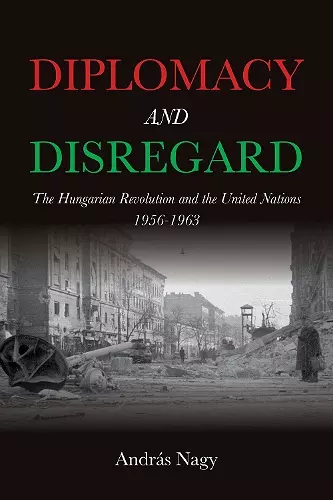
Between 1956 and 1963, the United Nations grappled with the "Hungarian question"; namely, what it should do about the events and aftermath of the country's 1956 Revolution. Cold War tensions, anxieties over the concurrent Suez crisis, and ignorance and indifference about Hungary influenced how UN member states responded to this "internal affair" and its potentially dangerous effects on international relations.
Diplomacy and Disregard draws upon previously inaccessible documents, including UN archival materials, Hungarian government and secret service papers, and personal collections held by UN officials across the globe, to reveal the UN's contradictory rhetorical and practical responses to the Hungarian Revolution. Through detailed overviews alongside case studies of individual diplomats and specific controversies, András Nagy traces the UN's reactions to Hungarian and Soviet authorities' blocking of resolutions and denunciation of the UN as an enemy power, its need to use the International Committee of the Red Cross as a channel for its humanitarian aid, and its inability to legitimize revolutionary leaders and allow them to represent and act on Hungary's behalf. Reports riddled with inconsistencies, failures to call emergency sessions and fulfill information requests, and lackluster responses to known acts of terror and espionage demonstrated that even at its highest levels of leadership, the UN was not only unable to intervene against the Soviet-supported government but was often unwilling to do so.
Diplomacy and Disregard provides an unprecedented look at the global reach and consequences of Hungary's 1956 Revolution and at how the UN's action and inaction during this political crisis ultimately defined its ability to maneuver the Cold War's fraught political landscape and live up to the ideals of its charter.
"András Nagy's work is at once a thorough academic treatise, a brilliantly documented polemic, a dramatic historical chronicle, and a reconstruction of events that is as precise as it could possibly be."—Gusztáv D. Kecskés—Professor, ELTE Research Centre for the Humanities, Institute of History
"By now, a vast amount of scholarship has appeared on the Hungarian revolution of October-November 1956 and the Soviet invasion that crushed it, but András Nagy manages to break valuable new ground by looking in-depth at the role of the United Nations (UN) throughout the crisis and its aftermath. The archival evidence and oral testimonies he has amassed enable him to present a fully convincing account. Nagy's book will be of great interest to scholars studying a wide range of topics, including the Cold War, international relations, the history of the UN, and East-Central European history. Indiana University Press deserves high praise for a superb edition of a truly remarkable book."—Mark Kramer—Director, Cold War Studies, Harvard University
"With this book, András Nagy fills important gaps in the history of the Cold War, the UN, and Hungary. His meticulous, years-long research enables him to complete the depressing picture of a world organization paralyzed by the Soviet veto, unable to assist a member country who was simply trying to get rid of an illegal and inhuman tyranny. He also deserves praise for bringing to light the obscure case of Povl Bang Jensen, to whom he had devoted a previous book, and Moscow's attempt to carry on reprisals against those who helped establish the truth about the Hungarian Revolution of 1956."—Federigo Argentieri—Director of the Guarini Institute for Public Affairs, John Cabot University
ISBN: 9780253070289
Dimensions: unknown
Weight: unknown
380 pages