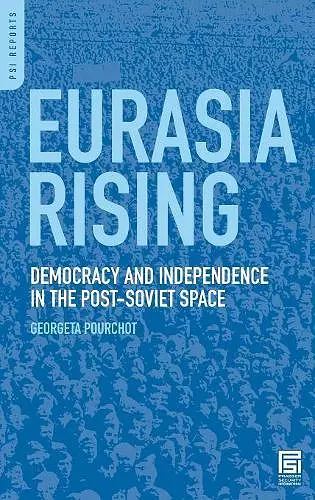
Eurasia Rising
Democracy and Independence in the Post-Soviet Space
Format:Hardback
Publisher:Bloomsbury Publishing PLC
Published:30th Jul '08
Currently unavailable, and unfortunately no date known when it will be back
"Eastern Europe countries have long been seen through the prism of the cold war standoff between the West and the old Soviet Union. This bias persists. Pourchot argues that this prejudice fails to comprehend the political dynamic underway in this region. She opens the door for a fresh look at an often neglected region." -- John J. Hamre, President and CEO, Center for Strategic and International Studies "At a time when Russia is raising growing concerns for its policies and intentions in Europe, Georgeta Pourchot is giving us a well balanced and persuasive history of the post-Soviet space that must be read and understood in full by students and practitioners alike. Students will learn not only what the facts are but also how facts should be managed into a coherent and sound analysis. As to practitioners, they will find in Pourchot's account a caution against the excessive shifts of mood that have characterized U.S. attitudes toward Eurasia over time." -- Simon Serfaty, Professor of US Foreign Policy and Eminent Scholar, Old Dominion University, Norfolk, Va. "Pourchot's examination of Eastern European and Central Asian national identities and interests provides an insightful perspective on the monumental shifts in Eurasia since the end of the Cold War." -- The Hon. Zbigniew Brzezinski, Counselor and Trustee, Center for Strategic and International Studies "Georgeta Pourchot's book Eurasia Rising: Democracy and Independence in the Post-Soviet Space gives an interesting account of the events in what is usually dubbed 'Russia's near abroad', a vast geopolitical area which, instead of being Russia's asset, turned into her burden and a source of endless troubles. Her book is certainly worth of academic attention due to the author's claim that the traditional/classical geopolitical considerations are not any longer sufficient for in-depth comprehension of the developments in the post-Soviet/post-Socialist area; instead, a set of more nuanced approaches is needed." -- Andrey Makarychev, Professor of History, Nizhny Novgorod State Linguistic University, Russia
Although the score of countries comprising Russia's "near abroad" and "far abroad" are behaving with variably increasing independence in their domestic and foreign policies, Russia continues to regard them as remaining within the same core-periphery sphere of influence formerly exerted by the Soviet Union.Although the score of countries comprising Russia's near abroad (the former non-Russian Soviet republics) and far abroad (the former non-Russian Warsaw Pact states) are behaving with variably increasing independence in their domestic and foreign policies, Russia continues to regard them as remaining within the same core-periphery sphere of influence formerly exerted by the Soviet Union within the same geographic space. Russia misinterprets bids by these countries to adopt liberalizing structural reforms and to join Euro-Atlantic organizations as foreign-inspired and inimical to Russia's security. Whether Russia can learn to recognize that such bids are in fact natural developments of national self-interest will determine whether healthy and mutually beneficial bilateral relations can develop between Russia and the states of her near and far abroad in the 21st century. No previous study of the dynamics of post-Soviet assertive sovereignty has as broad a geographic scope as Eurasia Rising, which considers the whole of Post-Soviet Space: DT Belarus, Moldova, Ukraine DT_ Estonia, Latvia, Lithuania DT Armenia, Azerbaijan, Georgia DT Kazakhstan, Kyrgyzstan, Tajikistan, Turkmenistan, Uzbekistan DT Albania, Bulgaria, Czech Republic, Hungary, Poland, Romania, Slovakia
Eurasia Rising: Democracy and Independence in the Post-Soviet Space gives an interesting account of the events in what is usually dubbed Russia's near abroad, a vast geopolitical area which, instead of being Russia's asset, turned into her burden and a source of endless troubles. Georgeta Pourchot's book is certainly worth of academic attention due to the author's claim that the traditional/classical geopolitical considerations are not any longer sufficient for in-depth comprehension of the developments in the post-Soviet/post-Socialist area; instead, a set of more nuanced approaches is needed… * Eurasian Home *
ISBN: 9780275999162
Dimensions: unknown
Weight: 425g
192 pages