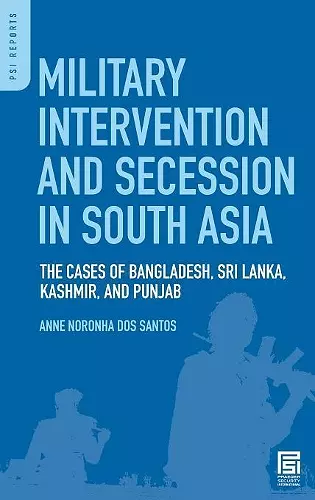
Military Intervention and Secession in South Asia
The Cases of Bangladesh, Sri Lanka, Kashmir, and Punjab
Format:Hardback
Publisher:Bloomsbury Publishing PLC
Published:30th Oct '07
Currently unavailable, and unfortunately no date known when it will be back
"Anne Dos Santos has written an important book on how civil wars become international. Drawing on the most advanced theories of international relations, she argues that anticipated changes in relative power cause states to crack down on secessionist groups and when combined with pre-existing rivalries, causes their sympathizers in other states to come to their defense. Her empirical work focuses on South Asia, a perfect laboratory for her research given its multitude of ethnic groups, some of which have sought secession, and a few of which have succeeded. Her book will be very helpful both to students of civil war and South Asian politics." -- Andrew H. Kydd Associate Professor Department of Political Science University of Wisconsin "In South Asia, the prospect of violent state secessions continue to threaten the stability of the region. Noronha has done an outstanding and original comparative study of past, present and potential state secessions in South Asia, and the prospect of international intervention and broader military conflict. This is a timely and well-researched book that advances our understanding of the comparative causes and consequences of violent state disintegration." -- Raju G. C. Thomas Allis Chalmers Distinguished Professor of International Affairs Marquette University
The stronger the alliance, the greater the chances of an international military intervention.
Understanding the conditions under which secessionist movements expand, become secessionist wars, and invite international military intervention on behalf of the secessionists has strong policy implications.
From Chechnya in Russia to Kashmir in India to the Basque region in Spain, secessionist movements remain a serious threat to international security. Despite the importance of this issue, the causes that bring about external military intervention in a secessionist war have not, until now, been adequately addressed. In this book, Dos Santos identifies the conditions that make international military intervention in a secessionist war more or less likely. South Asia, being fraught with secessionist movements—Bangladesh, Sri Lanka, Kashmir, and Punjab—provides an ideal laboratory for the examination of this compelling issue. Dos Santos argues that a shift in the balance of power between a secessionist group and its central government will lead to a preventive war on the secessionists by the central government. In turn, a preventive war of this nature may lead to an alliance between the secessionist group and an external power. The stronger the alliance, the greater the chances of an international military intervention. Understanding the conditions under which secessionist movements expand, become secessionist wars, and invite international military intervention on behalf of the secessionists has strong policy implications. It can go a long way toward guiding policymakers who may want to mitigate or avoid these conditions in their states. Dos Santos views both states and secessionist groups as primary actors, and she examines both the distribution of power among states and the balance of power between central government and groups within states.The author draws on some of the most advanced theories in international relations to develop a theory based on the relative power of various secessionist groups and their balance of power within a given state….This is a timely and well-thought presentation that advances the reader's understanding of the causes and consequences of violent state disintergration. * Parameters *
Santos (political science, California State U., Fullerton) develops a conceptual framework that identifies the conditions that make international military intervention more or less likely. She uses the framework to determine the range of possible outcomes of secessionist movements, including success, failure and stalemate, and then tests her theory against events in Bangladesh, Sri Lanka, Kashmir, and Punjab. The result is far more than a simple balancing of adherent and troop sizes but a careful examination of the complex elements that make up a secessionist movement, including the reasons for its inception, the aims of the movement in comparison to social and economic stability, the incidence of violence, and the nature of each sides' propaganda. * SciTech Book News *
ISBN: 9780275999490
Dimensions: unknown
Weight: 482g
216 pages