Nigeria's Stumbling Democracy and Its Implications for Africa's Democratic Movement
Victor Oguejiofor Okafor editor
Format:Hardback
Publisher:Bloomsbury Publishing PLC
Published:30th Jul '08
Currently unavailable, and unfortunately no date known when it will be back
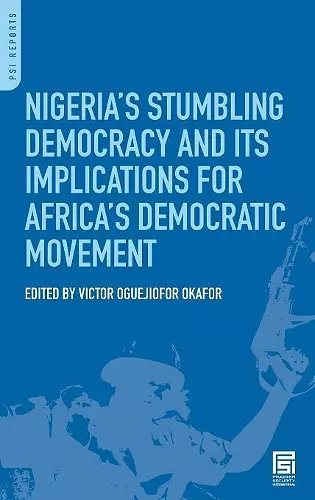
"Nigeria's Stumbling Democracy and its Implications for Africa's Democratic Movement brings into sharp focus the problematic of the electoral process in Nigeria--and by extension Africa--with the purpose of proffering solutions to electoral malfeasance. Drawing upon the wealth of knowledge of academics in Nigeria and the diaspora, Victor O. Okafor assembled a compendium of illuminating chapters in this volume that are useful to policymakers, students and Africanist scholars." -- Dr. E. Ike Udogu, Professor of African, Comparative and International Politics, Department of Political Science & Criminal Justice, Old Belk Library, Appalachian State University "This is an important book on an important country, Nigeria, whose democratic and developmental prospects have profound implications for Africa and the world at large. Focusing on the widely disputed elections of 2007, the editor has assembled a fine team of contributors who perceptively dissect Nigeria's checkered history of democratization. The strength of the book lies in the breadth and depth of its analyses, in which the 2007 elections are placed in the context of the political economies of colonial and postcolonial authoritarianisms, the disempowering dynamics of neo-liberalism, the opportunism of the political class, electoral malpractices, and lack of voter education, as well as in a comparative continental context." -- Paul Tiyambe Zeleza, Professor of African American Studies and History Liberal Arts and Sciences, Distinguished Professor Head, Department of African American Studies University of Illinois at Chicago
Offers an analysis of Nigeria's controversial general elections of April 2007, and the implications for the future of the democratic movement in Africa. This book provides an account of what went wrong with these disputed presidential, federal, and state elections.Nigeria's Stumbling Democracy and its Implications for Africa's Democratic Movement is the first book to recount and analyze Nigeria's controversial general elections of April 2007. Because Nigeria's immense and diverse population of 140 million people and its wealth of natural resources make it a microcosm of Africa, Nigerian politics are an ideal case study and bellwether by which to view and understand African politics and the ongoing democratic experiments on the continent. Ten leading scholars of Nigerian and African politics, variously based in Nigeria, the US, and Europe, contribute original chapters commissioned by Professor Okafor to provide an account at once deep and comprehensive of what went wrong with these disputed presidential, federal, and state elections; together with their implications for the future of the democratic movement, both in Nigeria and in Africa as a whole. Although the 2007 general elections resulted in the first-ever handover of political power from one civilian government to another in the history of Nigeria, by which the two-term Christian president Olusegun Obasanjon was succeeded by a Muslim, Alhaji Musa Yar'Adua, they were condemned by internal and international watchdogs for pervasive vote-rigging, violence, intimidation, and fraud which were, as this book documents, perpetrated by and with the connivance of the nation's security forces. The disappointment of continental hopes that these elections might finally break with Nigeria's history of tainted elections has grave repercussions for the democracy movement not only in Nigeria but throughout Africa-as seen in the knock-on effect upon the disastrous general elections in Kenya later the same year.
Bringing together contributions from political scholars from Nigeria, the United States, and Europe, Okafor (African American studies, Eastern Michigan U.) presents a collection that focus on the problems of the state, federal, and presidential elections in Nigeria in April, 2007 and their implications for democratic development in Nigeria and in Africa as a whole. Although the elections led to the peaceful hand-over of power from Olusegun Obasanjo to Alhaji Musa Yar'Adua, many critics, including internal and international poll observers, charged that the elections could not really be considered free and fair. The volume's 11 chapters summarize Nigeria's political evolution; place the 2007 election controversy in historical and international context; discuss the injection of commercialization into electoral politics; examine patronage politics and the elections in the Nigerian state of Anambra; explore the prospects of electronic voting for Nigerian elections; criticize the role of geographical zoning in the allocation of political and bureaucratic offices; place the 2007 elections in the context of general African political trends; compare the extrinsic factors impeding democratic development in Nigeria, South Africa, and Kenya; and draw lessons for democracy and development in Africa from the experiences of the African diaspora in the Americas.' * Reference & Research Book News *
…this volume is an important addition to academic libraries that support courses in African studies, politics, and international relations. * Catholic Library World *
ISBN: 9780313355868
Dimensions: unknown
Weight: 454g
208 pages