The Moving Word
How the West African and Caribbean Press Shaped Black Political Thought, 1935–1960
Format:Hardback
Publisher:Harvard University Press
Published:30th Jan '26
Should be back in stock very soon
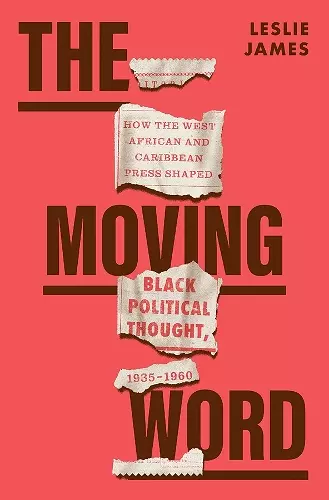
A revelatory account of Black Atlantic political thought in the era of decolonization, revealing how West African and Caribbean newspapers invigorated debates about imperialism, capitalism, and Black freedom.
In the 1930s and 1940s, amid intensifying anticolonial activism across the British Empire, dozens of new West African and Caribbean newspapers printed their first issues. With small staffs and shoestring budgets, these newspapers nonetheless became powerful vehicles for the expression of Black political thought. Drawing on papers from Trinidad, Jamaica, Ghana, and Nigeria, Leslie James shows how the press on both sides of the Atlantic nourished anticolonial and antiracist movements. Editors with varying levels of education, men and women journalists, worker and peasant correspondents, and anonymous contributors voiced incisive critiques of empire and experimented with visions of Black freedom. But as independence loomed, the press transformed to better demonstrate the respectability expected of a self-governing people.
Seeing themselves as “the Fourth and Only Estate,” the sole democratic institution available to a colonized population, early press contributors experimented with the form and function of the newspaper itself. They advanced anticolonial goals through clipping and reprinting articles from a variety of sources; drawing on local ways of speaking; and manipulating photography, comics, and advertising. Such unruly content, James shows, served as a strategic assertion of autonomy against colonial bureaucracy. Yet in the 1950s, this landscape changed as press professionalism became a proxy for a colony’s capacity to govern itself. Influenced by new political paradigms, papers either standardized their formats or stopped publishing altogether. By the 1960s, intellectual debates about racism and colonialism had moved to other kinds of publications.
Illuminating an extraordinary period in the history of Black Atlantic political thought, The Moving Word vividly portrays the power of experimental media.
Seminal in its contribution to the historiography of journalism by demonstrating the distinct power of the Press as a social institution and public good…gives much food for thought. * Tenement Yaad Media *
Leslie James’s exceptional study of print culture in the Anglophone Caribbean and West Africa deepens our understanding of the central role newspapers played in the politics of decolonization. Crisscrossing the Atlantic, The Moving Word expands the cast of characters associated with Black anticolonial thought, tracks the dynamic public sphere constituted by newspapers, and documents the diminished place of periodicals after national independence. This is a must read. -- Adom Getachew, author of Worldmaking after Empire
This book is nothing short of a tour de force, which will be required reading for decades to come. Leslie James meticulously fills out the scaffolding of Pan-Africanist thought, showing how presses in West Africa and the Caribbean made lively and dynamic contributions to debates about the meaning of Black freedom. -- Ato Quayson, author of Tragedy and Postcolonial Literature
The Moving Word conclusively documents how the African and Caribbean press shaped Black transnational political practice. As Leslie James's scholarship clearly reveals, political actors relied on newspapers to educate their reading publics and make arguments in support of decolonization movements globally. -- Carole Boyce Davies, author of Left of Karl Marx and Black Women's Rights
A beautifully written transatlantic print history of Black liberation. Leslie James illuminates the irreverent spirit of West African and Caribbean newspapers, showing how the circulation of news, opinion, poetry, and fiction connected diverse traditions of anticolonial resistance to one another and to a broader Black world. As she argues persuasively, this spirit was ultimately tempered—but never altogether tamed—by the politics and imperatives of decolonization itself. -- Carina Ray, author of Crossing the Color Line
The Moving Word persuasively expands the cast of figures who shaped Black political thought in the era of decolonization. As James shows, West African and Caribbean newspapers were circulating forms and political artifacts that influenced conceptions of Black freedom around the Atlantic. Tracing how these newspapers and their contributors changed between the 1930s and 1950s, this book challenges many assumptions about the relationship between the press, decolonization, and nation-building. -- Marc Matera, author of Black London
- Long-listed for Pauli Murray Book Prize 2026 (United States)
ISBN: 9780674279414
Dimensions: 235mm x 156mm x 27mm
Weight: 759g
384 pages