Democratic Elitism
The Founding Myth of American Political Science
Format:Hardback
Publisher:Harvard University Press
Published:25th Apr '25
Should be back in stock very soon
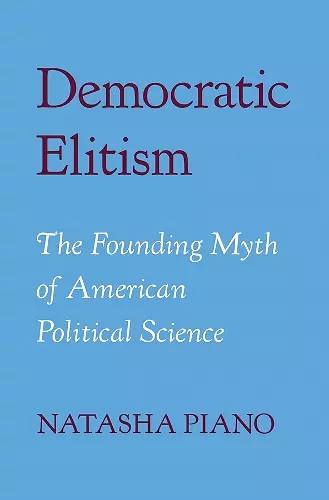
A searing argument—and work of meticulous scholarship—about how American political scientists misinterpreted the elite theory of democracy and in so doing made our political system vulnerable to oligarchic takeover.
Do competitive elections secure democracy, or might they undermine it by breeding popular disillusionment with liberal norms and procedures? The so-called Italian School of Elitism, comprising Vilfredo Pareto, Gaetano Mosca, and Robert Michels, voiced this very concern. They feared that defining democracy exclusively through representative practices creates unrealistic expectations of what elections can achieve, generating mass demoralization and disillusionment with popular government.
The Italian School’s concern has gone unheeded, even as their elite theory has been foundational for political science in the United States. Democratic Elitism argues that scholars have misinterpreted the Italians as conservative, antidemocratic figures who championed the equation of democracy with representative practices to restrain popular participation in politics. Natasha Piano contends not only that the Italian School’s thought has been distorted but also that theorists have ignored its main objective: to contain demagogues and plutocrats who prey on the cynicism of the masses. We ought to view these thinkers not as elite theorists of democracy but as democratic theorists of elitism.
The Italian School’s original writings do not reject electoral politics; they emphasize the power and promise of democracy beyond the ballot. Elections undoubtedly are an essential component of functioning democracies, but in order to preserve their legitimacy we must understand their true capacities and limitations. It is past time to dispel the delusion that we need only elections to solve political crises, or else mass publics, dissatisfied with the status quo, will fall deeper into the arms of authoritarians who capture and pervert formal democratic institutions to serve their own ends.
The sweep and coherence of Piano’s original synthesis is a landmark achievement…Revealing the Italian School to be bellwether critics of tendencies now thrust into the political spotlight, Democratic Elitism is a crucial read for future theorists of democracy. -- Robert P. Jackson * H-Diplo *
A thoughtful, well-researched, and highly original contribution to political theory. It still offers much to historians of economics, both for understanding classical questions in political economy and for exploring the development of modern social science. Above all, it reminds us that the transmission of ideas across national and disciplinary boundaries is rarely straightforward or unmediated. -- Gianluca Damiani * History of Political Economy *
[Piano] has written an excellent history…this is an important book. I’m glad I read it. All political scientists who work in or around democratic history should read it. Even if you think we ended up in the right place (as I do), it’s still worth understanding how we got here. Piano tells that story with lucidity and rigor. -- Brian Kogelmann * Philosophy and Public Affairs *
A towering achievement. It will alter the vectors of discussion among scholars of democratic theory and the history of American political science, and it will do so for the better. -- Nathan Hillel Feldman * American Political Thought *
Makes the striking claim that democracy and elections are opposed rather than complementary phenomena…Fascinating. -- John Ganz * Unpopular Front *
Through first-rate scholarship and beautiful writing, Piano shows how American political science continually fails to ‘breath the fine dry air of Florence’ when appropriating modern Italian thinkers, with consequences both scholastic—bad intellectual history—and political: failure to soberly confront the twin challenges of plutocracy and demagoguery. -- Gordon Arlen * Contemporary Political Theory *
Brilliant and bracing…As a deft blending of impressive historical and contextual readings and contemporary democratic theory, the book will be of interest to both intellectual historians and contemporary democratic theorists. -- Steven Klein * Perspectives on Politics *
Compellingly shows that modern political science has oversimplified democracy’s relationship with elections, and in doing so has obscured critical insights about elite power…Offers valuable resources for anyone concerned about the present and future trajectory of liberal democracy. -- Curtis Bram * Contemporary Sociology *
Democratic Elitism mounts a challenge to minimal conceptions of democracy, probing instead the tensions between the formal functioning of representative institutions and the substantive demands they are increasingly unable to satisfy. Equally noteworthy is the book’s sustained engagement with the opposition between optimism and pessimism, as well as its analytically productive effort to remove Italian Elitism from the long-standing shadow of Fascism and anti-democratic thought. -- Giovanni de Ghantuz Cubbe * History of European Ideas *
A well-written and accessible account of the threats that free and fair elections can pose to democratic energies. -- G. D. Mackin * Choice *
Natasha Piano makes a compelling case that generations of political scientists have misunderstood the elite theorists of democracy to be defenders of the elitism that they in fact attacked. More than this, she shows that they warned us of the ways in which demagogues can mobilize disaffected voters against democracies when they fail to deliver good government. This message is as timely today as it was in the 1930s. Democratic Elitism is essential reading for anyone who is troubled by the challenges that governments face across the democratic world. -- Ian Shapiro, author of Uncommon Sense
A bracing and imaginative history of ideas that inverts what we think we know about democracy and elitism. In this insightful book, Natasha Piano provokes us to think anew about democracy’s past and future, and asks whether the democracy we want can ever be tied to elections alone. -- Katrina Forrester, author of In the Shadow of Justice
In a brilliant revisionist account of early twentieth-century political theory, Natasha Piano shows how mid-century American political scientists perversely misread important critiques of elite self-dealing. In so doing, they limited the definition of democracy to the conduct of ‘free and fair elections’ between candidates pre-approved by economic and social elites. This book has startling relevance to our present democratic deficits. -- Nils Gilman, Chief Operating Officer and Executive Vice President of the Berggruen Institute
Natasha Piano offers an astonishing, captivating, and truly original interpretation of elite theory. Contrary to the agnostic reading of Italian elite theory that has dominated political science, Piano invites us to see it as an incipient critique of the oligarchic tendencies of representative government. -- Nadia Urbinati, author of Me the People
ISBN: 9780674295377
Dimensions: 235mm x 156mm x 16mm
Weight: 534g
256 pages