Slow Poison
Idi Amin, Yoweri Museveni, and the Making of the Ugandan State
Format:Hardback
Publisher:Harvard University Press
Published:31st Oct '25
Should be back in stock very soon
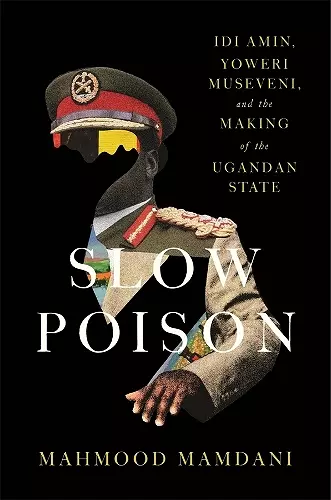
A leading public intellectual gives his authoritative and personal account of the tragic postcolonial fate of Uganda, his homeland.
In 1972, when Mahmood Mamdani came home to Uganda, he found a country transformed by “an orgy of violence.” Two years earlier, with support from the colonial powers of Great Britain and Israel, Idi Amin had forcefully cemented his rule. He soon expelled Uganda’s Indian minority in hopes of fostering a nation for Black Ugandans. The plan backfired. Amin was followed by Yoweri Museveni, who has now ruled for nearly four decades. Whereas Amin tried to create a Black nation out of the majority, Museveni sought to fragment this majority into multiple ethnic minorities, re-creating a version of colonial indirect rule.
Slow Poison is Mamdani’s firsthand report on the tragic unraveling of his country’s struggle for decolonialization. A witness to East Africa’s endlessly intricate power plays, and one of the most insightful political philosophers of his generation, Mamdani casts a learned and wary eye on Amin, internationally depicted as a buffoon; the radical scholar Museveni; and the global heavyweights that exploited and manipulated Uganda before and after its independence.
Each leader made violence central to his project, but Mamdani sees a signal difference between Amin, who retained popular support to the end, and Museveni, who has not. The Asian expulsion made Amin a monster in the eyes of the West. In contrast, Museveni was hailed as standard bearer of the “war on terror” in Africa and was protected from accountability for far greater crimes. In exchange for adopting the package of neoliberal reforms known as the Washington Consensus, he became Africa’s poster child. Amin, who aimed to create a nation of Black millionaires, never became one himself. Meanwhile, Uganda’s surrender to privatization has brought Museveni’s family immense wealth, even as the country remains one of the world’s poorest.
An extraordinary work of postcolonial history. -- Howard W. French * The Nation *
Mamdani’s love for his home country is unwavering even as he delivers blistering critiques of both Amin and Museveni. He minces few words describing what caused Uganda’s unraveling: tribalized politics, the corrupt privatization of state assets, and mass political violence. The book is at its most compelling when Mamdani tells his own story, mixing pathos and humor in equal parts. -- Zachariah Mampilly * Foreign Affairs *
Mamdani tells the story of his family’s exile—and his own eventual return—in hopes of complicating our view of Amin, and of Ugandan politics. Mamdani is less interested in the jubilation of independence than in the turmoil that followed. Africa’s transformation proved far bloodier than many had hoped, yet Mamdani still insists that the continent’s independence leaders have something to teach the world. -- Kelefa Sanneh * New Yorker *
Through a blend of memoir and scholarly analysis, [Mamdani] narrates the story of Amin’s rise and fall, and the long reign of Uganda’s current leader, Yoweri Museveni…the author hits his stride with his blend of historical analysis and personal recollection; his understanding of the period from both perspectives makes for propulsive reading. -- Bronwen Everill * Times Literary Supplement *
A personal account of Uganda’s last half century, covering both Amin and the autocrats who followed him…depict[s] Amin not as the buffoon that many remember but as a savvy political operator who knew what people wanted and what they feared. -- Samuel Fury Childs Daly * Los Angeles Review of Books *
A fascinating memoir. -- Howard French * Foreign Policy *
The book is informed by a hardheaded recognition that nation-building is often an ugly business, and that Amin’s crimes should be evaluated in that context. -- Geoff Shullenberger * Compact Magazine *
For half a century, Mahmood Mamdani has been one of the world’s most influential and incisive analysts of African and Global South politics. Slow Poison reveals why. Combining history, political critique, and memoir, the book offers a riveting account of the consequences of state-directed violence, ‘tribalization,’ and neoliberal privatization, as well as the various Western entanglements, upending a litany of myths surrounding Idi Amin, Yoweri Museveni, and modern Uganda. Mamdani makes for a compelling witness. Brilliant! -- Robin D. G. Kelley, author of Africa Speaks, America Answers: Modern Jazz in Revolutionary Times
Mahmood Mamdani is one of the most acute and resourceful observers of our world, but Slow Poison is exceptionally lavish in its offer of bracing insight and eye-opening exposition. Rarely has any one book captured the profound ambiguity of decolonization: the scrambled pursuit of national freedom, the tortuous negotiations and compromises behind declarations of sovereignty, and the sheer slipperiness of postcolonial power. -- Pankaj Mishra, author of The World After Gaza
Mahmood Mamdani is an author of much originality, and his latest book, Slow Poison, is an obvious testimony to his well-rounded brilliance. -- Nuruddin Farah, author of From a Crooked Rib
One isn’t always the master of one’s destiny, but for Mahmood Mamdani, remaining a spectator is not a valid option. Written like a novel, this book retraces the steps in the construction of the Ugandan nation, with the relevant critical stakes but above all reckoning with a long administered ‘slow poison.’ -- In Koli Jean Bofane, author of Congo Inc.
ISBN: 9780674299870
Dimensions: 235mm x 156mm x 22mm
Weight: 664g
352 pages