To Die For
The Paradox of American Patriotism
Cecilia Elizabeth O'Leary author
Format:Paperback
Publisher:Princeton University Press
Currently unavailable, and unfortunately no date known when it will be back
A brilliant and pioneering piece of scholarship... The most comprehensive account of the patriotic cultural wars of late-nineteenth-century America yet written, and an examination that will shape scholarship for years to come. -- John Bodnar, Indiana University
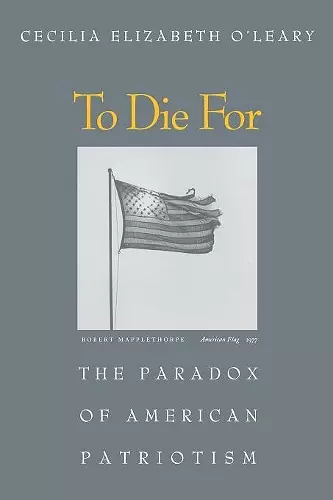
Traces the origins, development, and consolidation of patriotic cultures in the United States from the latter half of the nineteenth century up to World War I, a period in which the country emerged as a modern nation-state.July Fourth, "The Star-Spangled Banner," Memorial Day, and the pledge of allegiance are typically thought of as timeless and consensual representations of a national, American culture. In fact, as Cecilia O'Leary shows, most trappings of the nation's icons were modern inventions that were deeply and bitterly contested. While the Civil War determined the survival of the Union, what it meant to be a loyal American remained an open question as the struggle to make a nation moved off of the battlefields and into cultural and political terrain. Drawing upon a wide variety of original sources, O'Leary's interdisciplinary study explores the conflict over what events and icons would be inscribed into national memory, what traditions would be invented to establish continuity with a "suitable past," who would be exemplified as national heroes, and whether ethnic, regional, and other identities could coexist with loyalty to the nation. This book traces the origins, development, and consolidation of patriotic cultures in the United States from the latter half of the nineteenth century up to World War I, a period in which the country emerged as a modern nation-state. Until patriotism became a government-dominated affair in the twentieth century, culture wars raged throughout civil society over who had the authority to speak for the nation: Black Americans, women's organizations, workers, immigrants, and activists all spoke out and deeply influenced America's public life. Not until World War I, when the government joined forces with right-wing organizations and vigilante groups, did a racially exclusive, culturally conformist, militaristic patriotism finally triumph, albeit temporarily, over more progressive, egalitarian visions. As O'Leary suggests, the paradox of American patriotism remains with us. Are nationalism and democratic forms of citizenship compatible? What binds a nation so divided by regions, languages, ethnicity, racism, gender, and class? The most thought-provoking question of this complex book is, Who gets to claim the American flag and determine the meanings of the republic for which it stands?
One of Choice's Outstanding Academic Titles for 1999 "This study is not only well researched but also a sprightly written account of the development of modern American patriotism... This is truly a work 'to die for.'"--Choice "Well written ... O'Leary makes an important contribution to a growing body of scholarship that seeks to understand the vital role that rituals and symbols have played in the development of American nationalism."--Journal of Military History "[To Die For] has many thought-provoking insights... The best chapters in O'Leary's synthetic work are those on the Americanization of children and the detailed description of the GAR and WRC, in which soldiers and the women who nursed them, fed, and sewed for them readjusted to the union."--Civil War History "O'Leary's work breaks much new ground. To Die For belongs on any list of indispensable books for historians of ethnicity."--John McClymer, Journal of American Ethnic History
- Short-listed for Choice Magazine Outstanding Reference/Academic Book Award 1999
ISBN: 9780691070520
Dimensions: unknown
Weight: 567g
366 pages