The Routledge Handbook of Genocide Studies
John Cox editor Jeffrey S Bachman editor
Format:Hardback
Publisher:Taylor & Francis Inc
Publishing:9th Nov '26
£245.00
This title is due to be published on 9th November, and will be despatched as soon as possible.
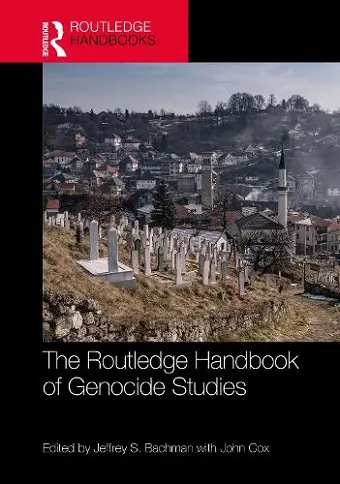
The field of genocide studies has experienced extraordinary growth during the past two decades. It stands today as one of the most diverse and interdisciplinary in the social sciences and humanities. Likewise, the field’s anchoring case studies have proliferated, from an initial focus on the Jewish Holocaust, the Armenian genocide, and the genocide of Tutsi in Rwanda, to a genuinely global framework that incorporates cases of genocide and other mass atrocities on every populated continent.
This handbook provides a cutting-edge overview of the discipline, blending theoretically grounded analysis with empirically rich illustrations to provide a state-of-the-art overview of the contemporary debates in genocide studies. Split into seven sections, the book covers:
- Roots and Causation
- Disciplinary Perspectives
- Genocide through History
- The Twentieth Century: Genocide Before the Convention
- Genocide Since 1948
- Interventions and Aftermaths
- Cultural Legacies
Bringing together a diverse set of both established and up-and-coming scholars, this volume will appeal to undergraduate and graduate students who are new to the field, to educators, and to scholars, researchers, and professionals in numerous fields who seek an encompassing understanding of genocide studies.
“This volume represents a major contribution to the field of genocide studies that will shape scholarship for years to come. It combines rigorous scholarship with moral urgency. It will be a vital resource for students, researchers, activists, policymakers, and all those committed to making ’never again’ a reality.”
Dr. James Waller, Christopher J. Dodd Chair in Human Rights Practice, University of Connecticut
“This handbook truly showcases the breadth and depth of the genocide studies field. The volume contains contributions from an impressive range of scholarly disciplines, bringing unique perspectives together into an extensive collection. The chapters provide both new insights on the theoretical and legal underpinnings of genocide as well as applications to under-studied episodes of genocide. This handbook will be an invaluable tool to scholars and instructors alike.”
Francesca Parente, Assistant Professor of Political Science and Director of the Reiff Center for Human Rights and Conflict Resolution, Christopher Newport University
“The Routledge Handbook of Genocide Studies assembles a group of talented emerging and established scholars from a variety of disciplinary perspectives, each presenting a novel examination of a key topic in this field of study. The book offers not only a comprehensive overview of genocide studies, but also pushes it in new and critical directions. It therefore serves as a vision for the field’s future as much as an overview of its past. Readers will discover both the vibrancy of genocide scholarship and the challenges faced in efforts to acknowledge, prevent, cease, historicize, narrate, represent, and redress genocidal violence.”
Andrew Woolford, Professor of Sociology and Criminology, University of Manitoba
“The Routledge Handbook of Genocide Studies is an essential resource for scholars, practitioners, and students alike. Editors Jeff Bachman and John Cox have curated a comprehensive volume that covers an impressive range of topics, from the legal frameworks surrounding genocide to the social, psychological, and political dynamics that duel these atrocities. The diversity of disciplinary approaches and case studies from around the world offers readers a nuanced, multifaceted understanding of genocide, making this handbook an invaluable tool for anyone seeking to engage with both the historical and contemporary challenges of mass violence.”
Kristina Hook, PhD, Assistant Professor of Conflict Management, School of Conflict Management, Peacebuilding, and Development, Kennesaw State University
“Comprised of analytical and case study entries from emerging and established scholars, the Handbook helpfully synthesizes long-standing debates in the genocide studies literature, captures the current state of the field, and points the way forward. It will surely become a well-thumbed volume on the bookshelves of students, academics, and practitioners alike.”
Maureen S. Hiebert, PhD, Associate Professor of Political Science and Research Fellow, Centre for Military, Security and Strategic Studies, University of Calgary
“The Routledge Handbook of Genocide Studies is a major contribution to the field of genocide studies. This comprehensive volume brings together leading figures and specialists from around the globe to address the phenomenon of genocide from a variety of perspectives, including gender, space, political regimes, war, perpetrators, the environment, culture, propaganda, music, images and memorials. These approaches revisit classic debates and topics from new angles, opening up new fields of enquiry with original and pertinent questions. Adopting a variety of analytical scales, the book combines an ambitious geographical scope — including national cases from all continents — with a broad timeframe. This book is undoubtedly a vital contribution not only to the academic world, but also to the general public who are committed to human rights, memory and world peace.”
Soledad Catoggio, PhD, Researcher at the Consejo Nacional de Investigaciones Científicas y Técnicas and Professor of Latin American Social History at the University of Buenos Aires
ISBN: 9780815362869
Dimensions: unknown
Weight: 453g
780 pages