Cyclonic Lives in an Indian Ocean World
Environment, Disaster, and Identity in Modern Mauritius
Format:Hardback
Publisher:Ohio University Press
Published:5th May '26
Should be back in stock very soon
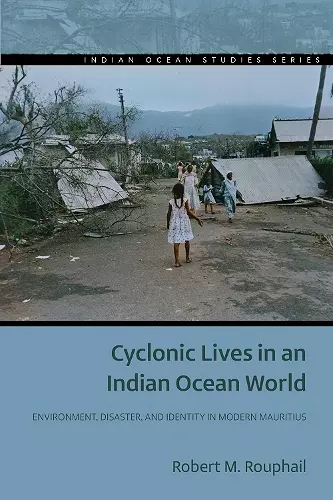
Disasters as historical processes shaping identity, governance, and diasporic memory in colonial and postcolonial Mauritius
In a world marked by increasingly destructive ecological and meteorological upheavals, Cyclonic Lives in an Indian Ocean World offers a historical analysis of how these catastrophes shape people’s understanding of themselves, their collective history, and their relationship to the institutions that govern them. An examination of cyclonic disasters in the multiethnic Indian Ocean island of Mauritius throws into stark relief how deep histories of diasporic identity formation, of imperial governance, and of the informal practices of racial difference making graft onto how everyday people interpret these moments of loss and the futures that emerge in their wake.
Cyclonic Lives shows that disasters are not only events; they are also processes through which people evaluate and rethink the most elemental social and cultural categories that give meaning to their lives. Beginning in the late nineteenth century and continuing until the early postcolonial era, this book tracks, for example, how Mauritians of African descent integrated these disasters into broader collective histories and memories of the Indian Ocean slave trade, how Hindu Indo-Mauritians understood cyclones’ ecological effects as material elements to be accounted for in a broader Hindu diasporic space, and how the late colonial and early postcolonial state built infrastructures-material, conceptual, and financial-to mitigate the threats posed by these storms and ensure their own long-term durability.
The increasing political, social, and economic instability that climate change has already triggered demands that humanists develop analytical geographies and methodologies that shed light on how power can modulate in asymmetrical ways at moments of crisis. If there is one central takeaway from this historical study of this small island in a big ocean, it is that catastrophic events are not things that merely happen to people; they are processes that remake them.
"Much more than an environmental and disaster history of an Indian Ocean island-nation, in this closely argued multiscalar study Robert M. Rouphail draws upon a wide range of rich documentation to complicate our understanding of how the lasting impact of cyclones has shaped the identity of modern Mauritians." - Edward A. Alpers, author of The Indian Ocean in World History
"Cyclones are not merely meteorological events or natural disasters in Mauritius. In this robustly argued and lucidly written book, Robert M. Rouphail shows us that cyclones are enduring conceptual categories that shaped Mauritian identities and social fabric, becoming constitutive of the history of an Indian Ocean society. Cyclonic Lives recalibrates debates within environmental history and disaster studies and will be indispensable reading for anyone concerned with the history of climate crisis." - Debjani Bhattacharyya, author of Empire and Ecology in the Bengal Delta: The Making of Calcutta
"In Mauritian collective memory, the cyclone is feared for the devastation it causes. Robert M. Rouphail has grasped the essence of the various ways that cyclones impacted Mauritius. And the aftermath: policies that impacted family life, gender roles, housing, moral values and ethnicity." - Vijaya Teelock, author of Mauritian History: From Its Beginnings to Modern Times
ISBN: 9780821426777
Dimensions: unknown
Weight: unknown
240 pages