Fiction, Memory, and Ethnic Politics in the South Caucasus
Peter Orte editor Mikail Mamedov editor Nona Shahnazarian editor Ulvi Ismayil editor
Format:Hardback
Publisher:Taylor & Francis Ltd
Published:30th Sep '25
Currently unavailable, and unfortunately no date known when it will be back
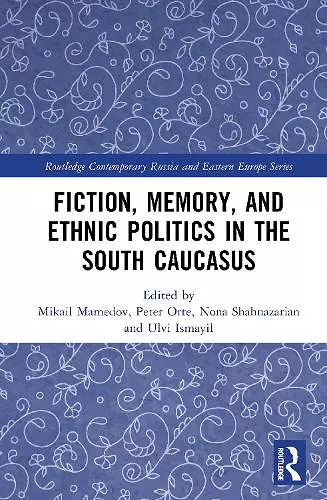
The book explores the aftermath of the disintegration of the Soviet Union and the effects of war and nationalism in the South Caucasus. While the Soviet Union’s dissolution seemed to promise democracy and liberalization, the rise of nationalist movements in Armenia and Azerbaijan led to those countries becoming undemocratic monoethnic states, which ethnically cleansed their largest minorities.
During the violence of the first stage of the Karabakh War (1992–1994), Armenians were expelled from Azerbaijan, and Azerbaijanis were expelled from Armenia. The persistence of this violent conflict through the second (2020) and third (2023) stages has led to competing, incompatible national narratives and an entrenched imagination of the other as the enemy. Explaining these events’ historical context by tracing them back to specific Soviet and Tsarist policies, the contributors of this volume examine the impact of the Karabakh conflict on ordinary people’s lives in Armenia and Azerbaijan by analyzing fiction, film, and other forms of public memory. Ultimately, they show how “eternal enmity” is a myth and point to potential solutions to the conflict.
This study will be useful to students and scholars of Soviet and Post-Soviet History, Nationalism, Empire, and Conflict Studies.
"This book is a small miracle: it explores the long-running Nagorny Karabakh/Artsakh dispute between Armenia and Azerbaijan by combining academic discourses that too often exist in isolation. Threading together current conversations in history, sociology, international peacebuilding, literature, and cinema studies, these writers examine some of the toughest issues that define the post-Soviet world. How does one build a successful twenty-first-century state? What role should nationalism based on ethnic identity play in state-building? How is collective memory created and shaped? Who benefits when artists use their art for political ends? What is the role of dissent in the post-Soviet context? How do local disputes affect diaspora communities? In this remarkable book, Mamedov et al. shine new light on seemingly intractable issues that bedevil not just the Caucasus region, but the wider world beyond."
-- Katherine E. Young, translator of Akram Aylisli, Poet Laureate Emerita, Arlington, Virginia, USA
"There is a steadily growing academic literature on various aspects of the South Caucasus. This ambitious book is an especially valuable addition to this body of knowledge, as it cuts across culture, historiography and politics to give us a unique account of how cultural voices have both fuelled and challenged narratives of conflict in a region, where protracted war and its legacy continues to negatively define its past and present. Combining well-known authoritative names, such as Viktor Shnirelman with newer voices from Armenia, Azerbaijan, Poland, and the United States, the volume critically changes our understanding of these issues with nuanced and innovative works of scholarship."
-- Thomas de Waal, Senior Fellow, Carnegie Europe, author of The Caucasus an Introduction and Black Garden, Armenia and Azerbaijan Through Peace and War
"A collection of papers by prominent experts who have published extensively about the Nagorno-Karabakh conflict, the volume is special in that it explores the wider context of relations between Armenia and Azerbaijan, and Armenians and Azerbaijanis. Rather than focus exclusively on politics, it looks through the lens of other social sciences - anthropology, sociology, history, and international relations. As a result, the volume succeeds in presenting the reader with a wide gamut of perspectives reflecting the contexts and positions of different countries and scholarly traditions. This makes this volume stand out among a multitude of publications that present partial views based on hand-picked evidence."
-- Alexander Iskandaryan, Director Caucasus Institute
ISBN: 9781032980157
Dimensions: unknown
Weight: 480g
210 pages