Informality, Class and Union Activism
Uniting what Capital Divides in Argentina
Format:Hardback
Publisher:Taylor & Francis Ltd
Published:19th Oct '26
£171.99
Supplier delay - available to order, but may take longer than usual.
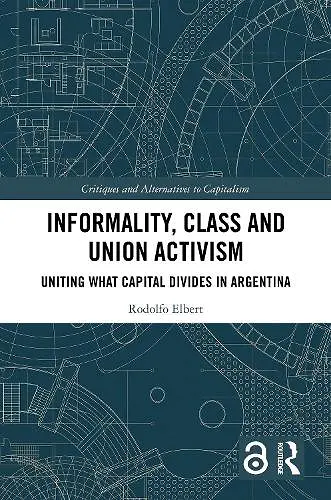
This book addresses the long standing Marxist question about the conditions in which a socially fragmented working class can forge a unified project, using a study of informality, class and union activism in Argentina between 2003 and 2011.
Informality, Class and Union Activism explores the articulations between the structural factors and the political strategies that characterize the formation of a working class in a dual economy. The first part of this book proposes a statistical analysis of survey research that shows that high informality in Argentina does not exclude multiple demographic ties between the different segments of the working class. In the second part of this book, the author proposes a comparative study of three factories in which unions’ political strategies become relevant to understand collective actions that aim to unify different segments of the working class. The combination of the statistical analysis with the comparative study of factory politics shows that the distinction between formal and informal workers does not translate into a class cleavage in Argentina. This evidence, as well as the creative methodological approach, stands to make an important contribution to the literature on comparative labor movements in the Global South.
Contributing to recent Marxist debates about class formation patterns of socially fragmented working classes, it will appeal to academics and scholars with interests in Marxism, informality, Latin American studies, and inequality.
The Open Access version of this book, available at http://www.taylorfrancis.com, has been made available under a Creative Commons Attribution-Non Commercial-No Derivatives (CC BY-NC-ND) 4.0 license.
‘Informality, Class and Union Activism is a remarkable book, challenging longstanding assumptions about how the enduring effects of neoliberalism and labor precarity have weakened worker solidarity. Focusing on how Argentina’s workers and activists have responded to changing workplace dynamics, Rodolfo Elbert analyses both qualitative and quantitative data to show how activists have mobilized informal workers and coordinated with traditional unions, giving us a new sense of what an inclusive 21st century labor movement might look like.’
Gay Seidman, Professor of Sociology, University of Wisconsin-Madison, USA
'This book offers a compelling exploration of class structure and labor politics during the progressive cycle in Latin America. Rodolfo Elbert combines statistical analyses of class and informality with a rich qualitative case study of factory politics to uncover the micropolitics of segmented corporatism, showing how union strategies at the workplace can challenge or reinforce the socio-economic segmentation of the working class. Theoretically sophisticated and empirically rich, this book makes an important contribution to contemporary debates on labor organization, class inequality, and worker representation. It is essential reading for scholars of labor, class, and political economy in Latin America and beyond.'
Pablo Pérez-Ahumada, Associate Professor of Sociology, University of Chile, Chile.
ISBN: 9781041008668
Dimensions: unknown
Weight: 440g
140 pages