Postmodernism and Architecture at the End of Apartheid
Format:Paperback
Publisher:Taylor & Francis Ltd
Published:16th Apr '26
Should be back in stock very soon
This paperback is available in another edition too:
- Hardback£171.99(9781041193081)
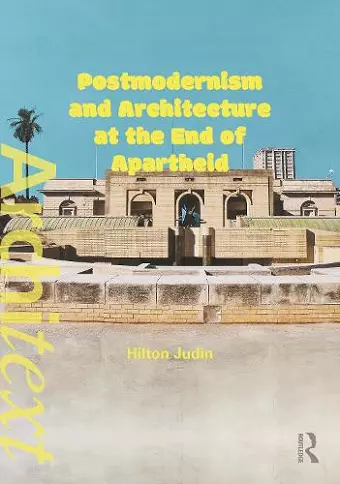
Set against a social and political urban landscape of segregation and forced removals, Postmodernism and Architecture at the End of Apartheid unpacks postmodernism in the 1970s and 1980s as it unfolds in South Africa during the final brutal decade of apartheid. Architecture and apartheid are central subjects of the book – the ways they came to interact simultaneously to both buttress and undermine a country rapidly disintegrating. With battles waged in defence of white minority rule, architects’ turn to postmodernism reflected their disintegrating consciences and commitments in operating in uncertain times.
They shared with architects globally a postmodernism steeped in anxiety and despondency, summoning forth classical forms and colonial symbols detached from their surroundings. For some of these architects having studied abroad at the University of Pennsylvania, the route to postmodernism was through their mentor Louis Kahn’s bid to begin architecture anew in transforming ancient ruins as a modern concrete and brick order. For others, influenced by compatriot Denise Scott Brown who had moved to the United States, it was learning by way of her "African view of Las Vegas."
Postmodernism and Architecture at the End of Apartheid expands on contemporary discourse in postmodernism and architectural theory, public culture, and urban spatial politics. It examines critical voices of the period – Robert Venturi, Paolo Portoghesi, Colin Rowe, Manfredo Tafuri, Fredric Jameson, and Kenneth Frampton – as well as questions of resistance in different forms and mediums, from the literature of Nadine Gordimer and J.M. Coetzee to grassroots struggle and community participation. Connections between postmodernism and apartheid are uncovered along with the contributions brought by architects in South Africa to a global postmodernism of newly transformed landscapes of neon strips, corporate temples, and white suburban sprawl amidst townships and growing informal settlements.
"While postmodernism in architecture has become historical, its history, resonances, and after-effects are not yet over. This insight becomes palpable as Hilton Judin brilliantly contextualizes the rise of postmodernist architecture in South Africa within the decades long struggle against segregation, forced removals, and apartheid in a disintegrating society. Transforming North American models in the urban South African context, postmodern architecture functioned either as nostalgic ornament or anxious defiance, reflecting conflictual social consciences and ideologies. A must read for anyone interested in the deep structures of the post-apartheid present."
Andreas Huyssen,Villard Professor Emeritus of German and Comparative Literature, Columbia University, and author of After the Great Divide: Modernism, Mass Culture, Postmodernism.
"South African architecture – colonial, deco and high modernist – have produced iconic reminders of its complex past. In this remarkable treatment of post-modernism, our foremost interpreter of South African architecture, Hilton Judin interprets this style as the ‘last salves lamentably applied to a wounded nation’."
Saul Dubow,Smuts Professor of Commonwealth History, Cambridge University, and author of Scientific Racism in Modern South Africa.
"While South Africa’s anti-apartheid struggle taught how to dismantle racism to the entire world and broke new ground in transitional justice and the expansion of human rights, this book demonstrates that architects’ turn to postmodernism during these years was a desperate attempt to perpetuate white dominion and urban segregation. Well-known architects and events long associated with postmodernism such as Denise Scott-Brown, 1980 Venice Biennale and CREDO magazine appear in new light when viewed from the perspective of Apartheid in South Africa, while local planning and design practices demonstrate architects’ choice between ignorance and complicity in oppressive regimes or resistance that fostered history-making change."
Esra Akcan, Professor, Department of Architecture, Cornell University, and author of Architecture and the Right to Heal: Resettler Nationalism in the Aftermath of Conflict and Disaster.
ISBN: 9781041193074
Dimensions: unknown
Weight: 610g
324 pages