Psycho-nationalism
Global Thought, Iranian Imaginations
Format:Hardback
Publisher:Cambridge University Press
Published:7th Dec '17
Currently unavailable, and unfortunately no date known when it will be back
This hardback is available in another edition too:
- Paperback£22.00(9781108435703)
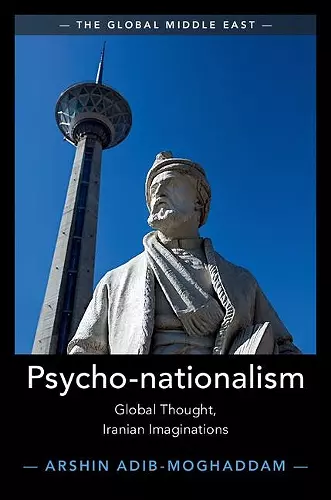
Psycho-nationalism explores the psychological and political roots of national identity and how these are often utilised by governments.
Psycho-nationalism focuses on the history of the use of Iranian identity under the Shah, as well as by the governments since the 1979 Iranian revolution, to offer an exploration into the psychological and political roots of national identity and how these are often utilised by governments.States routinely and readily exploit the grey area between sentiments of national affinity and hegemonic emotions geared to nationalist aggression. In this book, Arshin Adib-Moghaddam focuses on the use of Iranian identity to offer a timely exploration into the psychological and political roots of national identity and how these are often utilised by governments from East to West. Examining this trend, both under the Shah as well as by the governments since the 1979 Iranian revolution, Adib-Moghaddam's analysis is driven by what he terms 'psycho-nationalism', a new concept derived from psychological dynamics in the making of nations. Through this, he demonstrates how nationalist ideas evolved in global history and their impact on questions of identity, statecraft and culture. Psycho-nationalism describes how a nation is made, sustained and 'sold' to its citizenry and will interest students and scholars of Iranian culture and politics, world political history, nationalism studies and political philosophy.
'Sophisticated and innovative, Psycho-nationalism sheds new light on the persistent problem of nationalism. In what Arshin Adib-Moghaddam calls 'psycho-nationalism', the focus is less about, in reference to Ernest Gellner, a political principle with a homogenizing force, and more about disciplinary practices in shaping a cognitive regime of self and other, marked by policies of separation and political antagonism. However, as the case of Iran shows, such disciplinary mechanisms also involve sites of resistance, everyday defiances in redefining the state-society relations in the global era of (un)making nations. This is a book certain to generate discussion and have a major impact in cultural and socio-political studies.' Babak Rahimi, Director of the Program for the Study of Religion and Third World Studies, University of California, San Diego
ISBN: 9781108423076
Dimensions: 235mm x 157mm x 13mm
Weight: 390g
176 pages