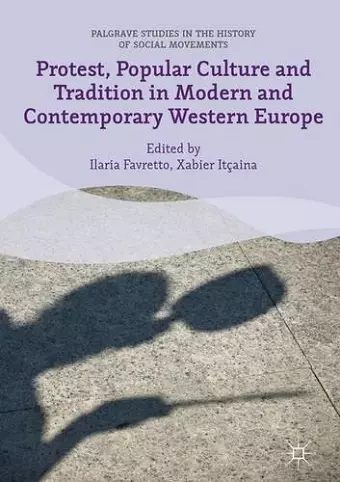
Protest, Popular Culture and Tradition in Modern and Contemporary Western Europe
Xabier Itçaina editor Ilaria Favretto editor
Format:Hardback
Publisher:Palgrave Macmillan
Published:18th Apr '17
Should be back in stock very soon
"This sparkling volume renews our understanding of the character of popular protest, from left to right, across modern Europe. The carnivalesque, the charivari, and other performative genres are drawn from the local past to try to overturn present injustice. Kudos to Ilaria Favretto and Xabier Itcaina for bringing together these essays, whose drama deepens our vision of political movements and their possibilities, even in our own day." (Natalie Zemon Davis, University of Toronto, Canada) "This finely crafted and very important edited volume by Ilaria Favretto and Xabier Itcaina, returns to the classic concerns of the New Social History of the middle and late twentieth century but with the advantage of employing the insights gained by a half century of New Social Movement theory, practice and studies. Thus the chiarivari and other so-called early modern and early industrial social phenomena never died. They are present in the industrial struggles of 1970s of Italy and indeed in the Alter-Globalisation, Occupy and Square movements of the early twenty-first centuries. In a series of invigorating chapters, this volume proclaims that the division between the pre-modern, modern and contemporary supply too much heat but not much light. Read and enjoy." (Professor Carl Levy, Goldsmiths, University of London, UK) "The history of social movements has taught us how in the nineteenth century trade unions and progressive parties, wanting to rationalize and impose order on popular dissent, waged war on the insults, satire, rowdiness and carnivalesque behaviours that had been rooted in popular tradition. These practices seemed relegated to the margins of protest action. However, the contributors to this volume describe the reinvention of an armoury of sedition, placing great emphasis on ridicule. This nuanced and rigorous enquiry into the resurgence of burlesque forms of protest makes for enthralling reading." (Francois Ploux, Universite de Bretagne-Sud, France)
Mock funerals, effigy parading, smearing with eggs and tomatoes, pot-banging and Carnival street theatre, arson and ransacking: all these seemingly archaic forms of action have been regular features of modern European protest, from the 19th to the 21st century.Mock funerals, effigy parading, smearing with eggs and tomatoes, pot-banging and Carnival street theatre, arson and ransacking: all these seemingly archaic forms of action have been regular features of modern European protest, from the 19th to the 21st century. In a wide chronological and geographical framework, this book analyses the uses, meanings, functions and reactivations of folk imagery, behaviour and language in modern collective action. The authors examine the role of protest actors as diverse as peasants, liberal movements, nationalist and separatist parties, anarchists, workers, students, right-wing activists and the global justice movement. So-called traditional repertoires have long been described as residual and obsolete. This book challenges the conventional distinction between pre-industrial and post-1789 forms of collective action, which continues to operate as a powerful dichotomy in the understanding of protest, and casts new light on rituals and symbolic performances that, albeit poorly understood and deciphered, are integral to our protest repertoire.
ISBN: 9781137507365
Dimensions: unknown
Weight: unknown
273 pages
1st ed. 2017