Armies and Ecosystems in Premodern Europe
The Meuse Region, 1250-1850
Format:Hardback
Publisher:Arc Humanities Press
Published:30th Apr '21
Currently unavailable, and unfortunately no date known when it will be back
This hardback is available in another edition too:
- Paperback£34.95(9781641894722)
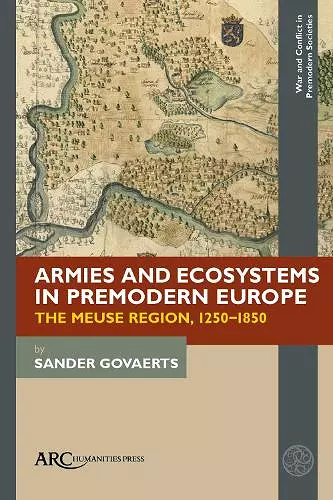
Using the ecosystem concept as his starting point, the author examines the complex relationship between premodern armed forces and their environment at three levels: landscapes, living beings, and diseases. The study focuses on Europe’s Meuse Region, well-known among historians of war as a battleground between France and Germany. By analyzing soldiers’ long-term interactions with nature, this book engages with current debates about the ecological impact of the military, and provides new impetus for contemporary armed forces to make greater effort to reduce their environmental footprint.
This book is available as Open Access.
This is an impressive interdisciplinary study, contributing to environmental history, the history of war and historical geography. The book advances an original and intriguing argument that armed forces have had a vested interest in preserving the environments and habitats in which they operate, and have thus contributed to environmental conservation long before this became a popular cause of wider humanity. The work will provide a template for how this topic can be researched for other parts of the world or for other time periods. -- Peter H. Wilson, Chichele Professor of the History of War
The interplay between warfare and the environment has received considerable attention from scholars of modern history. By contrast, there has been comparatively little scholarly discussion of the intersection of these two areas of historical inquiry in the medieval period. In this highly innovative study, Sander Govaerts, researcher in the department of history at Ghent University, seeks to address this lacuna through a longue durée investigation of a vast number of questions pertaining to the impact of armies on ecosystems as well as the influence of the natural environment on warfare in the Meuse river valley over a period of six centuries.
-- David S. Bachrach * German History 41, no. 2: 297–98 *Gaat het om de invloed van landschappelijke condities op de ontwikkeling van militaire structuren? Of staat juist voorop hoe en op welke wijze bijzondere ecosystemen al dan niet bewust door legers en soldaten zijn gecreëerd en behouden? Aan het slot slaat Govaerts op beide trommels door de ontwikkelingen op zowel het ene als het andere terrein samen te vatten. Hierdoor zouden dan volgens hem de traditionele interpretaties over de relatie tussen legers en de hun omringende wereld zijn ‘uitgedaagd’ of ter discussie gesteld. Dit moet in brede zin worden opgevat, want historiografisch gesproken worden er geen kastelen belegerd en geslecht. Dat neemt echter niet weg dat de lezer aan het eind van dit boek veel wijzer geworden is over de besproken thema’s, ook in hun samenhang. [...] Het is een studie die overtuigend het belang van de longue durée-aanpak en brede inkadering in de geschiedenis van landschap en leefomgeving toont. Onderstreept mag worden dat de auteur zeer belezen blijkt, veel nieuwe bronnen heeft aangeboord en zijn lezer vlot door het verhaal trekt. Een aanrader dus, met als extra pluspunten dat het werk goed geïllustreerd is en voorzien van een handzaam naamregister.
-- Hans Mol * Tijdschrift voor Geschiedenis 135, no. 4: 441-42 *Sander Govaerts offers a compelling and much-needed analysis of the relations between armed forces and environments. While there have been books by modern historians on the environmental history of the military, this is the first monograph to take the subject back to the medieval and early modern periods. Govaerts operates with expansive definitions of both keywords in his title: armies and ecosystems. The armies he investigates are not just personnel units in frontline battles – they are also castle guards, town garrisons, medical personnel, and cooks traveling with wagon trains. Within the author’s definition of ecosystem, readers learn about an incredibly wide array of topics: shrubs grown on city walls, soldiers picking berries, corpses thrown in ditches, hay provisioning for horses, and dysentery spreading in encampments, to name a few. This large remit allows the author to put together a sweeping view of how violent conflict (or the threat of it) altered environments in both the long and short term. […] Overall, the book is much more interesting and compelling than the factual book title conveys. The division of the book into thematic chapters really works and would make it easy to select just one chapter as a course reading. The book will be valuable for environmental historians who want to push back their thinking about armies and environmental change into the premodern era, as well as for military historians who want to understand the ecosystems created by armies.
-- Dolly Jørgensen * BMGN—Low Countries Historical Review 140 (2025): review 45 *ISBN: 9781641893985
Dimensions: unknown
Weight: unknown
320 pages
New edition