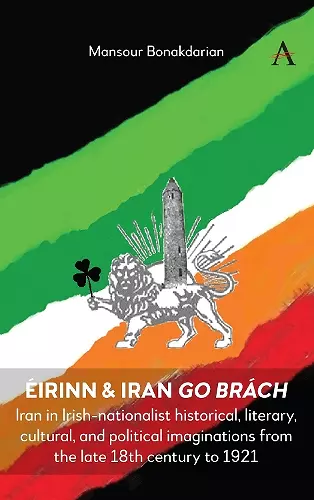
Éirinn & Iran go Brách
Iran in Irish-nationalist historical, literary, cultural, and political imaginations from the late 18th century to 1921
Format:Paperback
Publisher:Anthem Press
Published:2nd Dec '25
Should be back in stock very soon
This paperback is available in another edition too:
- Hardback£80.00(9781839989452)
Investigates patterns of Irish nationalist self-configuration and uses of memory, counter-memory, and historical amnesia from the late eighteenth century until Ireland’s partition and the founding of the Irish Free State in 1922 by means of “worlding” Ireland through the historical lens of “Iran.”
Approaching Irish nationalism through the historical lens of “Iran,” this book investigates patterns of Irish nationalist self-configuration and uses of memory, counter-memory, and historical amnesia by means of worlding Ireland from the late eighteenth century until Ireland’s partition and the founding of Irish Free State in 1922.
This book analyzes particular patterns of nationalist self-configuration and nationalist uses of memory, counter-memory, and historical amnesia in Ireland from roughly around the time of the emergence of a broad-based non-sectarian Irish nationalist platform in the late eighteenth century (the Society of United Irishmen) until Ireland’s partition and the founding of the Irish Free State in 1922. In approaching Irish nationalism through the particular historical lens of “Iran,” this book underscores the fact that Irish nationalism during this period (and even earlier) always utilized a historical paradigm that grounded Anglo-Irish encounters and Irish nationalism in the broader world history, a process that I term “worlding of Ireland.” In effect, Irish nationalism was always politically and culturally cosmopolitan in outlook in some formulations, even in the case of many nationalists who resorted to insular and narrowly defined exclusionary ethnic and/or religious formulations of the Irish “nation.” Irish nationalists, as nationalists in many other parts of the world, recurrently imagined their own history either in contrast to or as reflected in, the histories of peoples and lands elsewhere, even while claiming the historical uniqueness of the Irish experience. Present in a wide range of Irish nationalist political, cultural, and historical utterances were assertions of past and/or present affinities with other peoples and lands.
Recipient of Honorable Mention of the international Association for Iranian Studies’ 2024 Saidi-Sirjani Biennial Book Award.
“Mansour Bonakdarian offers a sustained, meticulously researched comparative history on Irish-Iranian entanglements spanning the long nineteenth century. Moving from the initial conduit of romantic orientalism toward a colonial lens on Imperial British world politics, it is a very welcome addition to the fields of Irish studies, nationalism studies, and comparative history.” — Joep Leerssen, Emeritus Professor, Universities of Amsterdam and Maastricht
“The worlding of Irish culture has a complex history, as Mansour Bonakdarian’s consummate study proves. Before Ireland was Europeanized, Irish writers and historians found a cultural fount in the history and culture of Iran. Bonakdarian expertly shows us the breadth of Irish-origin stories tying Érin and Iran—where they came from, what they overlooked, and how they inspired.” — Joseph Lennon, Villanova University, author of Irish Orientalism: A Literary and Intellectual History
“Bonakdarian’s fascinating study illuminates one of the lesser known aspects of intellectual history and nationalist historiography, that between Irish and Iranian nationalisms and the way in which they sought to contextualize their movements in relation to each other and wider liberation movements. A brilliant, penetrating study which deserves to be read widely.” — Ali M. Ansari, University of St Andrews
The book offers both substantive new knowledge and a methodological framework for understanding how nations imagine themselves through engagement with distant histories, ethical exemplars, and literary and cultural archetypes. ... [It] exemplifies a model of scholarship that integrates archival depth, literary sensitivity, ethical-historical analysis, and comparative insight.—Irish Studies Review
ISBN: 9781839996672
Dimensions: 229mm x 153mm x 44mm
Weight: 1034g
786 pages