What I Know I Cannot Say / All That Lies Beneath
Format:Paperback
Publisher:Parthian Books
Published:8th Nov '16
Should be back in stock very soon
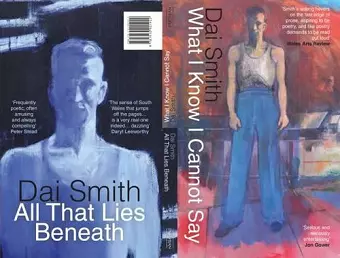
What I Know I Cannot Say / All That Lies Beneath combines a novella and a linked section of short stories to create a white-knuckle fiction ride through the South Wales Valleys during the 20th century. Power, sex, money and ambition all twist through the pages as Smith creates a feast of intellectual and physical provocation stories.
Picking up where his 2013 novel Dream On left off, What I Know I Cannot Say follows the life story of Billy’s father, Dai Maddox. When Billy’s former partner Bran shows up wanting to record Dai’s life story to put together a documentary, Dai looks back on his past, remembering his childhood as a destitute orphan, his work as a collier in the mines and the subsequent drifting between menial jobs, alleviated only by reading and drawing; his enrolment in the British Army and participation in the invasion of Italy during the Second World War; and post-war life under socialism, when he was back in the pits and married to Billy’s mother, Mona. Moving from the heyday of the pre-mechanised coal industry to the present day, What I Know I Cannot Say presents a moving and vivid panorama of twentieth-century Wales, brought to life by Smith’s meticulous attention to historical detail and distinct gift of invoking the smells, sights and sounds of the past. We find ourselves smelling the cordite of ammunition among the ruins of Cassino in 1943, during the invasion of Italy; the damp coal in the mineshafts; the beer-soaked wood of pub floors; the smell of fresh coffee from a modern percolator. Dai’s journey is an emotional and moving one, told in gritty, realistic prose. All That Lies Beneath is white-knuckle fiction ride: power, sex, money and ambition all twist through the pages as Smith creates a feast of intellectual and physical provocation in stories that send a shudder of fearful recognition directly through to the reader. -- Cyhoeddwr: Parthian Books
Picking up this book requires the reader to make a choice. The novella and collection of short stories that make up the slim volume What I Know I Cannot Say and All That Lies Beneath are published back to back. Not sequentially, but flipped so that, depending on which end you begin, you may find yourself drunk and boarding a train in upstate New York in the mid-1960s, or you might find that you’re shaving in south Wales in the mid-1980s. It’s not every book that has two potential page ones, but similarly it’s not every book that has an author like Dai Smith. Delving first into the short stories of All that Lies Beneath, ‘SoixanteHuitards, all’ is the story that begins in upstate New York. Welshman abroad, Bernard Jenkins, is spending Thanksgiving 1966 with his then girlfriend and a noted supporter of his university. Smith’s description of the home, lunch and conversation that flows wouldn’t be out of place in an early Philip Roth story. As the story goes on we’re transported later to a London commuter train in the late 1990s. Despite these settings, the real focus of the story is south Wales: in ‘SoixanteHuitards, all’, as in all of this collection, south Wales is always the focus. There’s an awful lot going on in this book and Smith is incredibly skilled at loading meaning into the simplest of narratives. For Bernard in the opening story, the narrative is simply a way to frame his sense of place in the world and, in turn, his sense of self. Only by being challenged and being far away from Wales and his family can he understand the influence the place has had. The sense of place dictates his sense of self, and time and hindsight come to show him that he’s perhaps never been fully true to himself. A similar exploration of place and identity comes later in the form of ‘The Bailey Report’ and its follow up, ‘Counteractual’ – two linked stories that really address self-perception and outsider perception. A spittle-covered old man confronts a patronising newsreader as he gives a piece to camera in a south Wales mining town. In ‘The Bailey Report’ the old man challenges the outsider: '…coming up ’ere, as if from another planet, taking your bloody pictures, making us all out to be ’opeless, dim-witted, doo-lally-tap, ‘elpless leftovers, relics.' He criticises how the news simplifies and reduces the locals’ lives and homes into something easily understood by a crude and well-worn stereotype of valley life. In ‘Counteractual’ this challenge is continued, this time articulately and away from the newsreader: '… it would not be helpful in the firmament of their fixed universe if we were to be discovered enjoying Beethoven, discussing Matisse’s cut-outs, or reading Updike and Mailer.' This sense of expectation and challenging of the neat narrative of history form the main theme of What I Know I Cannot Say, the novella on the flipside of the book. While What I Know … is, according to the publisher, picking up where Dai Smith’s novel Dream On left off, prior reading is not needed. Taking the form of a research interview for a radio show, the novella gives an insight into Dai Maddox, a former miner. Structured loosely around responses to eight fairly standard interview questions, Maddox’s narrative is both traditional and unsurprising, but also complex and deeper than a superficial interview would allow. His telling of his story is notable, clichéd as it may sound, as much for what he doesn’t say as for what he does say. What I Know I Cannot Say / All That Lies Beneath is a combination of stories that work incredibly well alongside each other. Smith’s sense of history and place is strong and this is well worth exploring as a masterclass of writing that far outshines the sum of its parts. -- Liam Nolan @ www.gwales.com
ISBN: 9781910901922
Dimensions: unknown
Weight: unknown
204 pages