Sultan, Caliph, and the Renewer of the Faith
Aḥmad Lobbo, the Tārīkh al-fattāsh and the Making of an Islamic State in West Africa
Format:Hardback
Publisher:Cambridge University Press
Published:19th Mar '20
Currently unavailable, our supplier has not provided us a restock date
This hardback is available in another edition too:
- Paperback£25.00(9781108789820)
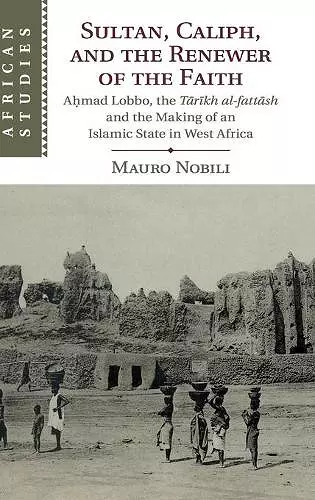
A significant re-examination of the Tārīkh al-fattāsh, revealing it to be a crucial nineteenth-century source for history in West Africa.
Representing a significant re-examination of the Tārīkh al-fattāsh, proved to be one the most important nineteenth-century sources for the history of West Africa, this study makes use of previously unpublished Arabic manuscripts to reveal the true author of the chronicle and its place in the evolution of West African civilization.The Tārīkh al-fattāsh is one of the most important and celebrated sources for the history of pre-colonial West Africa, yet it has confounded scholars for decades with its inconsistences and questions surrounding its authorship. In this study, Mauro Nobili examines and challenges existing theories on the chronicle, arguing that much of what we have presumed about the work is deeply flawed. Making extensive use of previously unpublished Arabic sources, Nobili demonstrates that the Tārīkh al-fattāsh was in fact written in the nineteenth century by a Fulani scholar, Nūḥ b. al-Ṭāhir, who modified pre-existing historiographical material as a political project in legitimation of the West African Islamic state known as the Caliphate of Ḥamdallāhi and its founding leader Aḥmad Lobbo. Contextualizing its production within the broader development of the religious and political landscape of West Africa, this study represents a significant moment in the study of West African history and of the evolution of Arabic historical literature in Timbuktu and its surrounding regions.
'A 'whodunit' par excellence! Nobili's engagement with the Tarikh al-Fattash and the Caliphate of Hamdullahi unravels their complicated, intertwined historiography. He reshapes our understanding of the whole Middle Niger region in the early-to-mid- 19th century and convincingly argues for a re-articulated meaning of authority and power as contested at the time. This book is seminal to the field.' E. Ann McDougall, University of Alberta, Canada
'A compelling work of historical and literary detective work, Nobili's study of the Tarikh al-Fattash is an important exploration of the role of Islamic literature and the unseen, in the legitimation of political authority in 19-century Africa. Focusing on the Sultanate of Ahmad Lobbo, Nobili demonstrates not only that the famed Tarikh was a work of relatively recent vintage based on earlier works, but that it was composed at least in part to substantiate Lobbo's claims to authority based on earlier esoteric prophecy. This timely work constitutes a substantial addition to the literature on the intersection between political authority and the Islamic 'unseen'. It will be important reading for anyone interested in Islamic political authority, historiography or the esoteric.' Scott S. Reese, Northern Arizona University
'A major contribution to the study of West African history.' Ousmane Kane, Cahiers d'études africaines
ISBN: 9781108479509
Dimensions: 235mm x 157mm x 20mm
Weight: 530g
288 pages