The Infernal Tambopata
British Slavery in Twentieth-Century Peru and Bolivia
Format:Hardback
Publisher:Liverpool University Press
Publishing:13th Nov '26
£125.00
This title is due to be published on 13th November, and will be despatched as soon as possible.
Ebook available to libraries exclusively as part of the JSTOR Path to Open initiative.
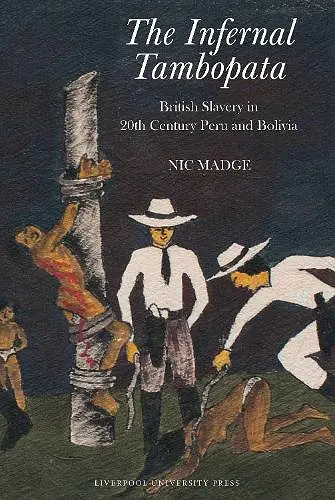
The Infernal Tambopata tells the story of a British-owned rubber company on the Peruvian–Bolivian frontier in the early twentieth century that, despite abolition decades earlier, systematically enslaved indigenous people.
Drawing on extensive unpublished company records, diplomatic correspondence and contemporary eyewitness accounts, it reconstructs how the Tambopata Rubber Syndicate recruited, confined and exploited its workforce under conditions of extreme violence, deprivation and coercion.
The book challenges persistent narratives that portray the “Rubber Boom” as socially benign, and reconsiders long-standing assumptions about British opposition to slavery. It reveals how British capital, commercial interests and diplomacy were all implicated in the creation and maintenance of brutally coercive labour regimes.
Combining meticulous archival research with a compelling narrative, The Infernal Tambopata recovers the lived experience of enslaved people and offers a powerful reappraisal of the human cost of the rubber industry. It also shows how forms of slavery persisted into the modern world, and why this history matters for understanding exploitation in today’s extractive industries.
"The Infernal Tambopata represents a major point of departure in the historiography of the rubber industry in the South America. The quality of the research is exhaustive. Every paragraph is packed with evidence and detail, and every angle and avenue has been explored across a remarkable range of subject areas: legislative, juridical, financial, medical, botanical, ethnographic, linguistic... This is a study that cannot be ignored. It should inform political debates and popular discourses around historical human rights abuses, modern slavery, reparations, and restorative justice."
Dr Jane-Marie Collins, University of Nottingham
"The Infernal Tambopata lives up to its name. Drawing on the internal records of the Tambopata Rubber Syndicate – a British company whose directors would go on to govern the Bank of England – this meticulously researched work reconstructs the hidden machinery of the rubber industry in the Peruvian and Bolivian Amazon… The Infernal Tambopata is essential reading for anyone seeking to understand how extractive capitalism, European colonialism, and state complicity shaped one of the darkest – and least documented – chapters in Amazonian history."
Dr Lorena Córdoba, Ca' Foscari University of Venice, Italy & CONICET (National Scientific and Technical Research Council), Buenos Aires, Argentina
"A remarkable work of historical scholarship that compels us to rethink what we know about the Amazon rubber boom and Britain's role within it. The horrors of the Putumayo atrocities are known and have long stood as one of the darkest chapters in the history of the Amazon rubber boom. Yet the prevailing narrative has often portrayed these crimes as the isolated excesses of a single company rather than evidence of a broader system of exploitation. Drawing on diaries, correspondence, and company records, this groundbreaking study challenges that assumption... By reconstructing life at the Tambopata Rubber Syndicate's remote barracas with exceptional archival precision, the book restores the voices and experiences of Indigenous workers while exposing the human cost of imperial capitalism. Rich in archival detail and compelling in its human focus, this book transforms our understanding of British participation in Amazonian rubber extraction. A major contribution to the histories of empire, capitalism, Indigenous peoples, and human rights, it compels readers to confront the enduring human costs of imperial commerce."
Dr Silvia Escanilla Huerta, University of Maryland Baltimore County
"Drawing on extensive archival research, The Infernal Tambopata offers a much-needed contribution toward better understanding the Peruvian Rubber Boom, a period of intense economic growth and expansion in the Amazon rainforest that was not only accompanied by horrific human abuses but rested upon cruelty. The book brings attention to histories that have long remained at the margins of studies of exploitation and slavery of local and Indigenous Peoples in Latin America. Significantly, Madge’s meticulous research connects the Tambopata region to wider national, European and global predatory circuits, yet most specifically to a British owned rubber company which perpetuated extreme violence to attain a prized commodity. This work sheds light on how British participation in slavery and debt peonage systems extended beyond its key roles in the transatlantic trade and its Empire. The result is a sober, necessary addition to the field that will prompt further research and debate."
Dr Daniela M. Peluso, Emeritus Fellow, School of Anthropology and Conservation, University of Kent
"Using an impressive range of archival sources from the British Isles, Peru and Bolivia, Nic Madge paints a richly detailed but depressingly bleak picture of debt peonage in a British company at the height of the Amazon rubber boom. Workers contracted on the Peruvian and Bolivian altiplano suffered coercive and exploitative conditions, starvation and death, in a remote area which was effectively closed to diplomatic and legal authorities. The contemporary Putumayo scandal may have attracted much more attention, but it is clear from Madge's research that comparable conditions were a widespread feature of rubber extraction elsewhere in the western Amazon."
Dr Rory Miller, University of Liverpool
"Anyone interested in the Latin American rubber boom knows about the violence in Putumayo thanks to the scandal caused by Roger Casement’s reports. Nic Madge has expanded our knowledge to the Tambopata valley region of Peru and Bolivia. His careful archival research demonstrates how the abuse, exploitation, and peonage common in Putumayo played out in an entirely different region. Using records related to the Tambopata Rubber Syndicate, Madge pieces together a history of rampant mistreatment of Syndicate employees and a blind eye from British officials. Readers will wonder why Parliament and the press decried atrocities in Putumayo but ignored similar issues in Tambopata. Madge makes a compelling case that British ownership of the Tambopata Rubber Syndicate made their abuses too scandalous even for an exposé. A century later, The Infernal Tambopata tells the story with a clear, unflinching voice."
Professor David Squires, University of Louisiana at Lafayette
'Nic Madge, a leading humanitarian lawyer, provides the most thoroughly researched account so far of the atrocities that took place in the Amazon during the Rubber Boom around the turn of the last century. These were first exposed by Hardenberg in his book The Devil’s Paradise. Together with the subsequent reports of Sir Roger Casement on the enslavement and tortures inflicted on the indigenous tribes of the Putumayo Valley this shocked the world. It is deeply disturbing in this day and age to learn from Madge that the form of slavery known as ‘debt bondage’ continues, affecting many hundreds of thousands of people in the world, the majority of whom are working in extractive industries that are contributing to the presaged destruction of the earth and life upon it. The bell is beginning to toll for all of us.'
Philip E. Howse, OBE, Professor Emeritus in Biological Sciences, University of Southampton
"The Infernal Tambopata is a shocking and important book which demonstrates quite clearly that British involvement in slavery by no means ended in the nineteenth century. Its graphic accounts of the institutional cruelty, violence and privation meted out by British rubber companies operating in Peru in the early twentieth century are horrifically compelling. Slave systems must always be interrogated, wherever and whenever they occur. Superbly researched and written, Madge's work takes this challenge into an overlooked and crucial area."
**Dr. Sue Blundell, The Open University **
ISBN: 9781805969426
Dimensions: unknown
Weight: unknown
352 pages